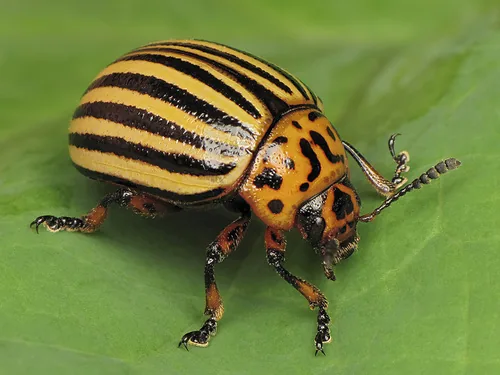
Field Identification
If new growth is curling, yellowing, sticky, or chewed, colorado potato beetle may already be on the plant. This pest often builds quietly, then damage appears all at once. Feeding stress weakens growth, reduces yield, and opens the door to secondary disease. Early cleanup is much easier than fighting a full population surge later.
Inspect the newest growth first: leaf undersides, flower buds, stem joints, and tender tips where pests gather. Look for body shape, color, eggs, cast skins, honeydew, webbing, or fresh puncture marks. A hand lens and a white paper tap test help reveal small life stages. Matching visible pests with fresh plant damage confirms active infestation.
Not sure what you have? Use the symptom diagnosis tool →
How to Deal With It
Organic Control Methods
Bacillus thuringiensis tenebrionis (Bt t) specifically kills Colorado potato beetle larvae -- it is the only Bt strain that works on beetles rather than caterpillars. Apply to small larvae thoroughly coating leaf surfaces. Spined soldier bugs (Podisus maculiventris) are the most important predator -- they pierce and consume larvae and can be purchased commercially. Ladybugs and ground beetles eat eggs and small larvae. Beauveria bassiana fungal spray infects adults and larvae -- apply in humid conditions for best efficacy. Rotate all materials to prevent resistance -- Colorado potato beetle develops pesticide resistance faster than almost any other pest.
Colorado potato beetles overwinter as adults in soil and woodland edges, emerging in spring when potatoes sprout. They are the most pesticide-resistant agricultural pest in North America -- populations in many areas are resistant to virtually every conventional insecticide. Rotate potato beds at least 100 feet from the previous year location -- adults walk to find host plants and distance matters. Scout leaf undersides weekly for bright orange-yellow egg masses. Finding and crushing egg masses is the highest-value preventive activity -- one mass contains 20-30 eggs that become the most damaging larval generation.
Deep straw mulch (6+ inches) interferes with adult movement from soil to plants and with larval movement from plants back to soil to pupate -- one of the most effective cultural controls available. Plant early trap crops of potato at bed edges -- beetles emerge hungry and colonize trap crops first, allowing targeted removal. Flaming or vacuuming trap crops with beetles on them eliminates large numbers. Remove overwintering habitat along wooded edges near potato beds. Plant later in season to miss the first overwintering generation.
Hand-pick adults and larvae into soapy water -- feasible and surprisingly effective for small garden beds. Check daily during peak season. Vacuum plants with a handheld vacuum in early morning when beetles are sluggish. Row covers from planting until flowering exclude adults from reaching plants -- the most reliable mechanical control when installed before adults emerge. Remove covers at flowering for pollination.
Spinosad provides strong knockdown of adults and larvae -- apply at dusk to minimize bee exposure, rotate with other products to prevent resistance. Bt tenebrionis on small larvae coating leaf undersides thoroughly. Neem oil (azadirachtin) disrupts larval molting and reduces adult feeding. Beauveria bassiana in humid conditions. Never rely on one product all season -- Colorado potato beetle resistance develops within a single season of repeated exposure to the same mode of action.
Let Nature Handle It
Natural Enemies
- Spined Soldier Bug
- Ladybugs
- Ground Beetles (Carabidae)
- Parasitic Flies (Tachinidae)
Threat Map