Field Identification
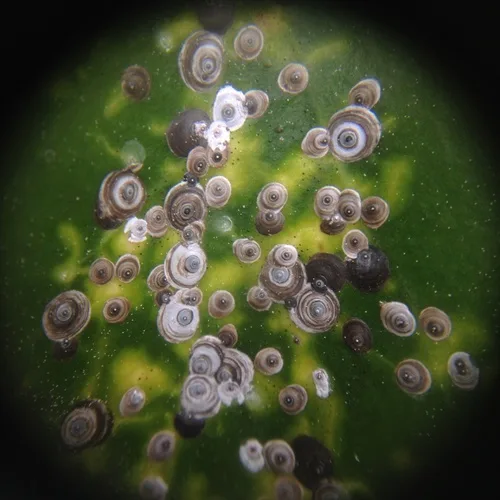
Armored scales are immobile sap feeders protected by a hard wax cover separate from the insect body. They often look like tiny fish scales or bumps glued along stems and leaf veins. Populations build slowly, then yellowing, die-back, and sooty mold from honeydew-producing partners appear as secondary issues. They are common on woody ornamentals and fruit across humid subtropical to temperate climates.
Use a lens: the cover lifts off the surface while the soft insect body remains underneath on some species. Unlike soft scales, armored types do not excrete large amounts of honeydew themselves, but plants may still show decline from chronic sap loss. Scratch tests help -- if the cover pops free and a yellow or purple smear appears, the insect is alive. Track crawler timing with double-sided tape wrapped near existing scales during warm months.
Not sure what you have? Use the symptom diagnosis tool →
How to Deal With It
Organic Control Methods
Aphytis and Comperiella spp. parasitoids attack many diaspidid scales in citrus and ornamental systems. Lady beetle Chilocorus stigma feeds on several armored species when crawlers are exposed. Preserve flowering insectaries so parasitoids have nectar during adult flight. Avoid broad-spectrum sprays during crawler windows because the vulnerable stage is when biocontrol agents work best.
Inspect nursery stock before planting and reject heavily infested liners. Quarantine new acquisitions in bright light for two weeks while checking undersides of leaves and stem joints. Do not over-fertilize with quick-release nitrogen, which pushes succulent growth scales colonize faster. Maintain steady soil moisture so plants do not alternate between drought stress and flushes of tender tissue.
Prune out the most encrusted twigs when infestations are localized, bagging debris for municipal green waste if available. Open canopy interiors on dense shrubs to improve spray penetration and predator access. Ants farming honeydew from neighboring soft scales can protect scales from predators -- manage ant routes with sticky barriers or bait stations using products labeled for your setting. Replace chronically infested hedging varieties with resistant selections where breeders have documented lower scale loads.
For small plantings, a soft toothbrush and soapy water scrub removes many covers and exposes crawlers to desiccation. Pressure washing can dislodge scales on sturdy bark but risks cambial injury on thin-barked species if pressure is too high. Double-sided tape captures crawlers during emergence peaks when refreshed every few days. Hand removal is tedious but effective on specimen trees where chemical use is undesirable.
Horticultural oil during dormancy smothers overwintering scales when labels allow for your species and temperature range. In-season, narrow-range summer oil timed to crawler emergence hits the unprotected stage -- repeat according to label intervals because residual is short. Insecticidal soap helps on soft new growth where complete coverage is possible. Rotate oil and soap rather than stacking rates, because repeated heavy oil in heat can damage foliage.
Let Nature Handle It
Natural Enemies
- Parasitic Wasps
- Ladybugs
- Predatory Beetles
Threat Map