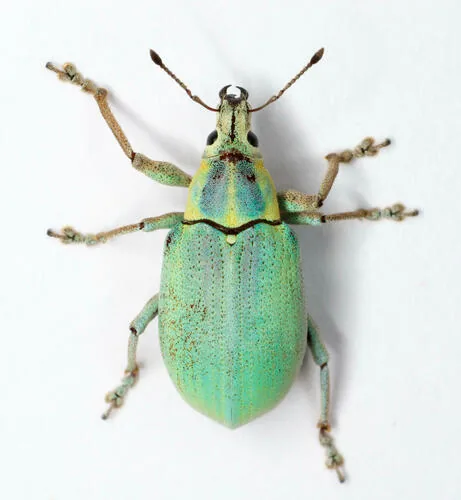
Field Identification
If plants are wilting, notching at the edges, or fruit and roots show hidden feeding damage, citrus root weevil may be the cause. Adults chew above ground while larvae often feed out of sight inside soil, stems, or fruit. Damage builds quietly, then plants crash fast when roots are heavily hit. Act early so a small weevil problem does not become a season-long infestation.
Look for small beetles with a hard body and a distinct snout, usually active at dawn, dusk, or night. Check for crescent-shaped leaf notches, punctures in fruit, or tiny entry holes near stems. In soil or damaged tissue, larvae are often pale, legless, and curved in a C-shape. Fresh chew marks plus snout beetles or C-shaped grubs confirm active weevil pressure.
Not sure what you have? Use the symptom diagnosis tool →
How to Deal With It
Organic Control Methods
Entomopathogenic nematodes -- Heterorhabditis bacteriophora and Steinernema riobrave -- applied under irrigation are the most effective organic biological control for citrus root weevil larvae in soil. Apply when soil is moist and above 60F (15C), saturating the root zone thoroughly. Repeat every 6-8 weeks during warm months. Ground beetles and ants scavenge weevil eggs and young larvae in soil -- permanent organic mulch supports ground beetle populations.
Adult citrus root weevils notch leaf margins in a characteristic scalloped pattern -- this is the most visible sign of infestation. Adults feed at night and hide in soil or leaf litter during the day. Larvae feed on roots underground and cause the most serious damage -- plants decline mysteriously before adult feeding is noticed. Inspect nursery stock carefully before planting. Monitor notching on new flush weekly from spring through fall.
Maintain mulch depth of 3-4 inches under trees to support beneficial nematodes and ground beetles -- but keep mulch away from trunk bases to prevent crown rot. Remove excessive weed groundcovers that provide adult weevil habitat. Proper irrigation maintains the soil moisture that beneficial nematodes need to survive and move through soil toward larvae.
Sticky trunk bands prevent wingless adult weevils from climbing to feed on new flush -- apply in spring before adults emerge and check weekly. Shake adults from small trees onto sheets in cool mornings when they are sluggish. Tree skirts of hardware cloth buried at the drip line reduce adult movement into the root zone.
Beneficial nematodes (Heterorhabditis bacteriophora, Steinernema riobrave) applied as a soil drench are the primary organic treatment -- saturate the root zone and keep soil moist for 2 weeks after application. Apply in late spring and again in late summer. Kaolin clay on foliage deters adult feeding and egg-laying. Beauveria bassiana soil drench suppresses larvae where available and labeled.
Let Nature Handle It
Natural Enemies
- Heterorhabditis bacteriophora
- Steinernema riobrave
- Ground beetles
Threat Map