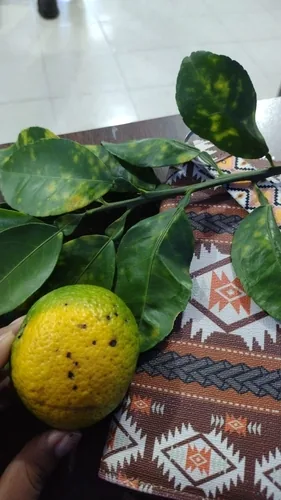
Field Identification
If leaves, stems, or fruit suddenly look spotted, sunken, or rotting, citrus greening may already be active. This problem often starts small, then spreads across healthy tissue before most growers realize how serious it is. Warmth, moisture, and crowded foliage usually speed it up. Treat early, because waiting even a few days can turn a manageable infection into major crop loss.
Look for a pattern, not one bad leaf: expanding spots, dark or pale halos, fuzzy growth, or tissue that collapses when touched. Check both leaf surfaces, stem bases, and fruit scars where symptoms first appear. New lesions after rain, overhead watering, or heavy dew are a strong clue. When separate spots begin merging into larger dead patches, the disease is advancing quickly.
Not sure what you have? Use the symptom diagnosis tool →
How to Deal With It
Organic Control Methods
Tamarixia radiata is a parasitic wasp that specifically attacks Asian citrus psyllid nymphs — it has been released in Florida and California as part of government biocontrol programs and is establishing in many areas. Do not spray broad-spectrum insecticides during psyllid flush periods — you will kill Tamarixia and other beneficial insects that provide long-term suppression. Lacewings, lady beetles, and minute pirate bugs eat psyllid eggs and nymphs. Support these by maintaining diverse flowering plants near citrus. There is no biological control for the greening bacteria itself — all biological effort must focus on suppressing the psyllid vector.
Citrus greening (HLB — Huanglongbing) has no cure. Once a tree is infected it will decline and die, though it may produce fruit for years. The only strategy is preventing infection by controlling the Asian citrus psyllid vector. Psyllids lay eggs exclusively on new flush growth — the tender pink-yellow new growth that citrus produces periodically. Scout every flush emergence for psyllid eggs (yellow elongated eggs standing upright on new leaves) and nymphs (yellow-orange flat disk-shaped insects with waxy tubes). Only plant certified disease-free budwood and trees from licensed nurseries.
Coordinate psyllid management with neighbors — citrus greening spreads at a neighborhood scale and one unmanaged tree undermines everyone nearby. Remove infected trees when required by regulation or when they are no longer productive — infected trees are permanent psyllid and disease reservoirs. Manage flush timing with controlled irrigation and fertilization — trees that flush synchronously present a narrower window for psyllid management. Remove volunteer citrus seedlings which are unmanaged psyllid hosts. Report suspected citrus greening symptoms to your state department of agriculture immediately.
Screen houses physically exclude psyllids for high-value young trees and nursery stock — the only complete mechanical exclusion available. Yellow and blue sticky traps monitor psyllid adult movement into the planting. Reflective mulch under trees disorients psyllids landing olated small plantings, fine mesh row covers during flush periods prevent psyllid access to the new growth where eggs are laid.
Kaolin clay applied to new flush growth before and during psyllid flight creates a physical barrier that deters egg-laying on tender leaves — apply every 5-7 days during flush periods. Neem oil on new growth disrupts psyllid feeding and egg-laying behavior. Insecticidal soap kills nymphs on direct contact — coat new flush growth thoroughly. Copper, neem, or soap sprays must be timed to new growth flushes — there is no point spraying between flushes when psyllids are not reproducing. These sprays manage psyllid populations but cannot cure trees already infected with the greening bacteria.
Let Nature Handle It
Natural Enemies
- Tamarixia radiata
- Diaphorencyrtus aligarhensis
- Lady Beetles
Threat Map