About
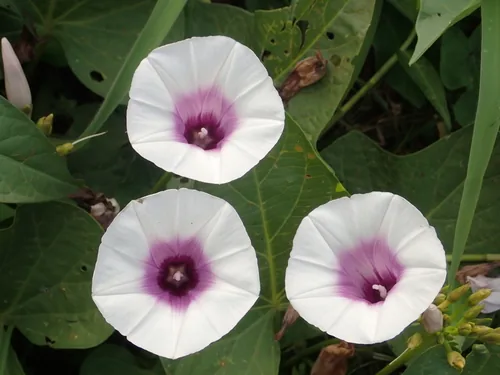
Sweet potato is a herbaceous perennial vine native to tropical regions of the Americas. It features heart-shaped or lobed leaves and bears funnel-shaped flowers, typically in shades of pink or violet. The plant is primarily cultivated for its edible tuberous roots, which vary in color from white and yellow to orange and purple, depending on the cultivar. Sweet potatoes thrive in full sun, requiring at least 6 hours of direct sunlight daily. They prefer well-drained, loamy to sandy soils with a slightly acidic to neutral pH (5.5 to 6.5). Consistent moisture is essential, especially during the establishment phase and root development, but waterlogging should be avoided to prevent root rot. Propagation is typically achieved through "slips," which are shoots grown from mature sweet potato tubers. To produce slips: 1. Select healthy, disease-free tubers. 2. Place them in a warm, moist environment, partially submerged in water or soil. 3. After several weeks, sprouts (slips) will emerge. 4. Once slips reach approximately 15 cm (6 inches) in length, they can be gently removed and planted directly into the soil. Harvesting usually occurs 90 to 170 days after planting, depending on the variety and growing conditions. Indicators for harvest include yellowing leaves and the size of the tubers. It's advisable to harvest before the first frost, as cold temperatures can damage the tubers. Carefully dig up the tubers to avoid bruising, and cure them in a warm, humid environment for about 7 to 10 days to enhance sweetness and storage potential.
Permaculture Functions
- Edible: Storage roots finish from ninety to one hundred seventy days depending on cultivar -- orange types carry high beta-carotene for fresh roasting, purple types hold anthocyanins that stay vivid when steamed instead of boiled hard.
- Ground Cover: Running stems root at nodes and knit a living mat that smothers pigweed and crabgrass between corn rows -- while keeping soil surface temperature down in August sun.
- Animal Fodder: Vines harvested before frost replace part of dairy silage in humid tropics -- tuber culls go cooked to pigs to avoid raw bulk that can ferment in the gut.
- Pollinator: Dawn-opened pink funnels give nectar to early bees and hawkmoths on weeks -- when the main crop flowers are not yet open.
- Mulcher: Frost-killed vines lay flat as winter cover on the bed -- shallow fibrous roots decay in place and leave channels that spring beans root into without extra tillage.
Companion Planting
No companion data yet.
Also mentioned as companions:
- Corn
- Bean
- Marigold
Not yet profiled in PermiePortal
- Squash
Threats & Pressure