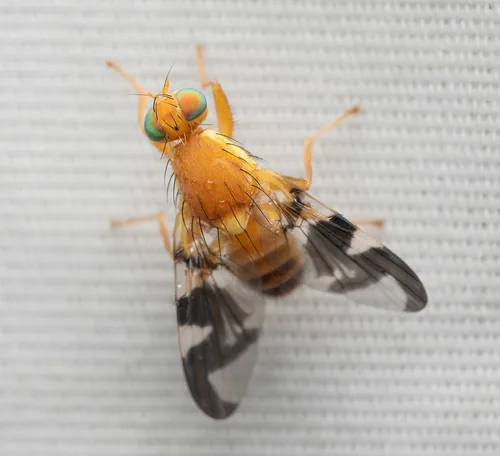
Field Identification
If leaves show trails, fruit turns soft, or roots collapse from inside, walnut husk fly may already be feeding. The larval stage does most of the damage, often hidden where you cannot see it at first glance. By the time yellowing or rot appears, feeding may be well underway. Move quickly when symptoms begin to prevent another wave of eggs and larvae.
Watch for tiny eggs near plant tissue, pale legless larvae inside mines or fruit, and sudden soft spots or tunnels. Adults are usually small flies that hover or dart when disturbed. Check around wounds, blossoms, and moist plant debris where egg-laying is common. Cut open suspect tissue: live maggots or fresh tunnels are the clearest field confirmation.
Not sure what you have? Use the symptom diagnosis tool →
How to Deal With It
Organic Control Methods
Parasitoids attack Rhagoletis flies modestly; robber flies and spiders pick off adults at sap feeds. Birds learn to hunt flies near damaged husks. These helpers trim edges; they do not fix orchards where every neighbor drops husks until winter. Skip pyrethrin during peak parasitism or you farm flies alone next month.
Hang yellow sticky spheres baited with ammonium carbonate to mark biofix when adults first move -- that date sets spinosad or kaolin windows. Treat only when catches cross regional thresholds, not every Tuesday. Coordinate neighborhood sanitation; adults fly orchard to orchard in summer.
Destroy fallen husks weekly so larvae cannot pupate under trees. Remove unmanaged wild walnuts near edges if rules allow. Mow or rake under trees so husks do not sit in wet thatch. After harvest, remove residue quickly; leftover husks are next year's fly factory.
Sticky spheres and panels capture adults for monitoring and mass trapping when many traps cover a block; one trap near the porch mostly rearranges flies. Shake trees after harvest where permitted to drop stubborn husks. Fine mesh bags on individual nuts exclude flies on backyard trees if labor allows.
Spinosad targets adults during the short pre-oviposition window; read labels for walnut and timing. Kaolin clay repels landing flies if you rebuild film after rain -- organic programs lean on obsessive timing, not calendar sprays. Reapply after irrigation or rain washes kaolin off. Combine sprays with trap counts; empty sprays waste money and predators.
Let Nature Handle It
Natural Enemies
- Parasitic Wasps
- Robber Flies
- Spiders