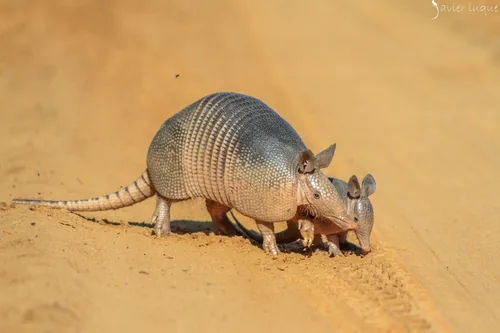
Field Identification
If your garden beds look like something dug random holes overnight — 3 to 5 inches deep, conical, scattered with no pattern — an armadillo was there. They do not eat plants directly. They are after grubs, earthworms, beetle larvae, and soil insects, and they find them by smell, punching through mulch and root zones to get them. A food forest with rich biology and deep mulch is an armadillo paradise. One animal can excavate dozens of holes per night and uproot seedlings, bulbs, and shallow-rooted plants without ever intending to.
Look for conical digging holes 3-5 inches wide and deep, scattered randomly across beds rather than following a trail. Disturbed mulch and uprooted small plants at the dig sites. Armadillos are active primarily at dusk, dawn, and overnight — you may hear rustling or see them directly. They follow regular patrol routes along fences, beds, and woodland edges. Tracks show three prominent claw marks. Fresh digging appears in the same general area night after night until the food source is exhausted or they are deterred.
Not sure what you have? Use the symptom diagnosis tool →
How to Deal With It
Organic Control Methods
Armadillos are following their food — grubs and soil larvae. Reducing grub populations with beneficial nematodes (Heterorhabditis bacteriophora) and milky spore reduces the food source that attracts armadillos in the first place. This is a slow multi-season strategy but the only biological approach available. A well-established food forest with predatory ground beetles and healthy soil food web has fewer grubs overall — mature systems are less attractive than newly planted beds with disturbed soil. No predators effectively control armadillo populations in suburban or rural Florida.
Armadillos follow their nose — they smell grubs and larvae through 8 inches of soil. Fresh compost, recently planted beds, and heavily mulched areas smell like a buffet to them. Newly established food forest plantings are highest risk. Armadillos are nearsighted and follow routine patrol routes along edges and fence lines — identifying and blocking these corridors is more effective than trying to deter them from the whole property. They are most active in warm months but active year-round in Florida. A single armadillo has a home range of 8-30 acres and will return nightly if food is available.
Hardware cloth buried 12 inches deep and bent outward at the bottom around individual raised beds or high-value planting areas is the most reliable long-term protection. Armadillos cannot jump but they dig — the outward bend at the bottom prevents them from tunneling under. For food forest guild areas, protect new plantings individually until established — mature deep-rooted plants survive armadillo disturbance much better than seedlings and recent transplants. Roll up or remove deep mulch from beds you are actively trying to protect — thick mulch is exactly what they dig through to reach grubs.
Live trapping with a wire cage trap (12x10x32 inch minimum) is the most effective mechanical control. Bait with overripe fruit, earthworms, or sardines placed at the back of the trap. Set along fence lines and woodland edges where armadillos travel — placement on the route matters more than bait. Check traps morning and evening. Relocate at least 5 miles away to a suitable rural area — check Florida regulations on relocation before doing so. Fencing with hardware cloth or smooth metal sheeting 24 inches high along patrol routes redirects movement without trapping. Armadillos are surprisingly fast when startled but cannot climb smooth surfaces.
Castor oil granules or liquid concentrate applied to beds and lawn areas creates a scent and taste armadillos find repellent — they stop digging in treated areas because the earthworms and grubs taste wrong after castor oil penetrates soil. Apply after rain or water in thoroughly. Reapply every 2-4 weeks and after heavy rain. This is the most practical non-trapping option for large areas. Cayenne pepper and predator urine (coyote, fox) have inconsistent results — armadillos have poor eyesight but excellent smell and may habituate to these over time. Castor oil is the most documented and consistent repellent available. Long-term perimeter strategy: a dense lemongrass hedge planted as a continuous border creates a physical root mat armadillos cannot dig through and a volatile oil barrier their sensitive noses actively avoid. Plant lemongrass divisions 18 inches apart and allow to clump for 2 full seasons — once established the root mass becomes impenetrable. This is a permanent solution that also provides harvests. Nothing short-term works reliably — blocking patrol routes and reducing grub populations while the perimeter establishes is the honest answer.
Let Nature Handle It
Natural Enemies
- Coyotes
- Bobcats
- Black Bears
- Large Raptors