About
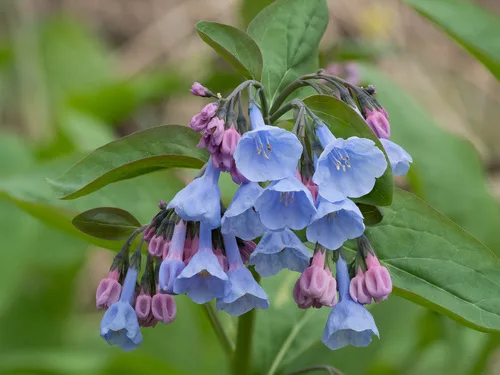
Virginia bluebells (Mertensia virginica) is a spring ephemeral of eastern North American floodplain forests, pushing succulent stems through leaf litter and opening clusters of pink buds that mature to sky-blue trumpet flowers. Plants reach 30 to 60 cm (1 to 2 feet), then go dormant by early summer, leaving room for later-season companions. Leaves are broad and glaucous, often coloring well before senescence. It suits shaded rain gardens, riparian buffers, and native woodland gardens in cool-temperate climates with rich, moist soils. Partial to full shade with consistently moist, humus-rich, well-drained soil matches ecology; drought during emergence reduces vigor sharply. Sow seed outdoors in autumn after ripening, or divide dormant crowns carefully because fleshy roots resent disturbance. Enjoy bloom in the cool wet season; allow foliage to yellow naturally before cutting, because nutrients recycle to roots for the next year.
Permaculture Functions
- Pollinator: Long-tongued bees visit early tubular flowers -- timing bridges earliest spring ephemerals and later woodland forbs.
- Ornamental: Blue floral masses contrast with spring woodland greens -- designers use drifts under deciduous trees for seasonal color without summer maintenance.
- Wildlife Attractor: Early nectar supports pollinators when canopy is still open -- pairs with other spring ephemerals for stacked resources.
- Ground Cover: Dense basal leaves exclude annual weeds briefly in moist shade -- plan succession with ferns and sedges that expand as bluebells fade.
- Erosion Control: Fibrous roots stabilize rich alluvium on gentle slopes -- useful along swales where moisture remains after storms.
Companion Planting