About
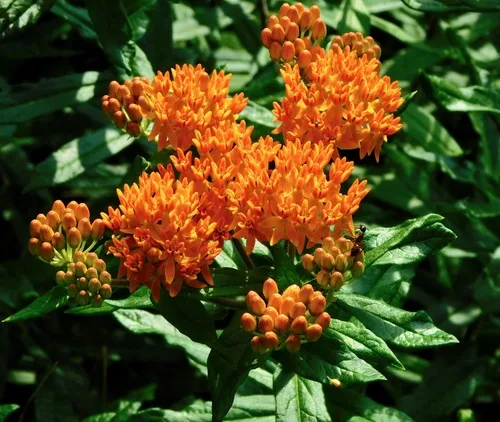
Butterfly milkweed (Asclepias tuberosa) is a taprooted prairie and savanna perennial with stiff, hairy stems, narrow leaves, and flat-topped clusters of bright orange to yellow flowers in midsummer. Unlike many milkweeds, its sap is less milky and its roots form deep orange taproots that resent disturbance. Mature plants reach 30 to 90 cm (1 to 3 feet) and are a primary host for monarch and queen butterfly larvae in eastern and central North America. It belongs in sunny meadow plantings, roadside pollinator strips, and dry rain-garden berms where drainage is sharp and winter cold stratifies seeds naturally. Full sun is required for strong bloom and disease resistance. Lean, well-drained sand or gravel soils suit it better than rich, wet clay; drought tolerance is high once established. Sow seeds outdoors after cold stratification, or start indoors 6 to 8 weeks before last frost with scarification. Transplant young seedlings while small because taproots snap easily. Collect pods before they split on dry, windy days; seeds float on silken floss. Leave late-season stems standing for overwintering insect habitat.
Permaculture Functions
- Pollinator: Nectar-rich umbels feed bees, wasps, and butterflies during peak summer heat -- long bloom bridges early and late forage gaps in restored prairies.
- Wildlife Attractor: Foliage feeds Danaus plexippus larvae; flowers support diverse insects -- plant in drifts so caterpillars do not defoliate single specimens.
- Ornamental: Saturated orange flowers contrast with grasses and purple coneflowers -- low maintenance compared to thirsty annual color beds.
- Medicinal: Pleurisy root appears in historic Eclectic materia medica for respiratory support -- internal use is obsolete without expert supervision due to cardenolide chemistry.
- Erosion Control: Deep taproot anchors sandy slopes and disturbed rights-of-way -- useful on berms where shallow-rooted turf washes away.
Companion Planting