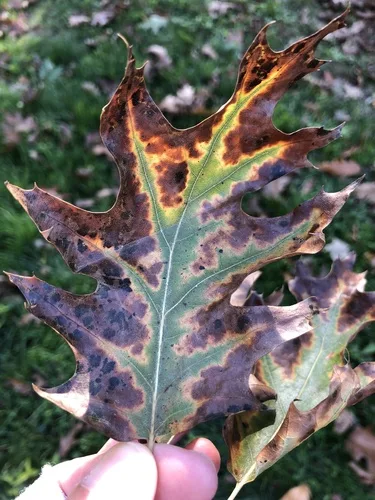
Field Identification
Leaf scorch is a pattern name for marginal or interveinal browning that advances inward while veins may stay greener for a time. Causes include drought stress, root restriction, salt accumulation, trunk injury, vascular pathogens, and rapid transpiration on hot windy days. Maples, oaks, and many urban trees show it first on the sunniest side of the crown. Diagnosis requires checking soil moisture, roots, irrigation water salts, and recent site disturbance together.
Look whether symptoms are uniform around the crown or sectorial from root loss on one side. Compare with anthracnose, which often follows veins differently and shows fruiting bodies under wet periods. Check emitters and mulch depth for buried root flare. Laboratory tests confirm Xylella or other vascular pathogens where geography and hosts warrant.
Not sure what you have? Use the symptom diagnosis tool →
How to Deal With It
Organic Control Methods
Where scorch ties to root rot complexes, building diverse soil biology with compost and mulch supports secondary feeder root regeneration after drainage is fixed. Mycorrhizae help nutrient scavenging but do not replace water. Beneficial antagonists like Trichoderma are tools for some root pathogens when used as part of an integrated plan. None of these override chronic over-fertilization or salt-laden irrigation water.
Mulch outward from the root flare without piling on the stem. Irrigate deeply on a schedule matched to soil texture instead of light daily sprinkles. Leach containers occasionally if soluble salts climb. Choose windbreaks or shade cloth for young transplants during extreme heat events when establishment is fragile.
Decompact root zones with radial trenching or air spade methods where arborists recommend for girdling roots. Adjust fertilizer programs after soil and foliar testing -- excess potassium or magnesium imbalances can mimic or worsen scorch. Prune dead tips after stress ends to reduce secondary pest entry points. For street trees, advocate for adequate soil volume at planting time because restricted roots cause chronic scorch.
Remove plastic burlap and wire baskets from root balls at planting. Reroute foot traffic that compacts the dripline. Repair irrigation leaks that keep one sector saturated while another dries. Whitewash thin bark if summer pruning suddenly exposes wood to sunscald that pairs with leaf scorch symptoms.
Foliar sprays do not fix vascular limitation or salt toxicity in soil. Seaweed extracts and humates may buffer stress marginally but are not substitutes for water management. If bacterial leaf scorch (Xylella) is confirmed, follow regulatory guidance -- there is no home organic spray cure. Focus budget on irrigation auditing and soil correction.
Let Nature Handle It
Natural Enemies
- Beneficial Fungi
- Competitive Microbes
- Antagonistic Bacteria