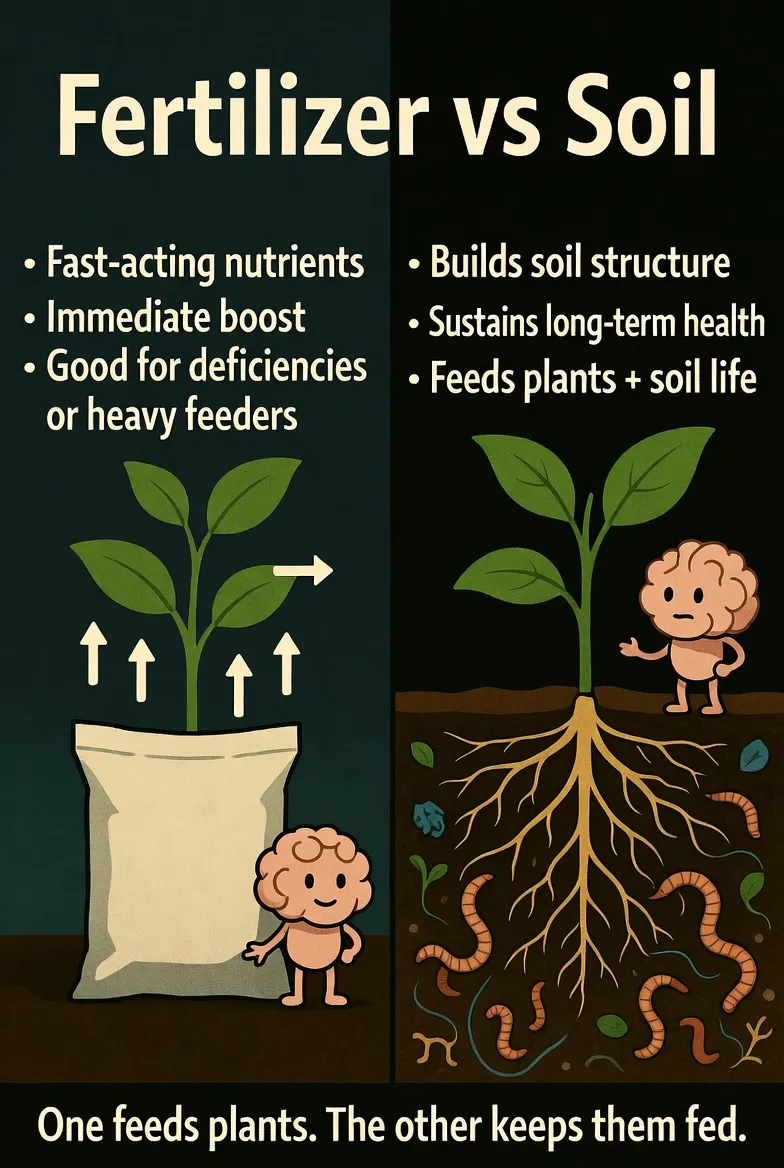
Most plant problems don’t start with a lack of nutrients.
They start with how those nutrients are delivered.
If you’ve ever fertilized a plant, watched it surge with growth, and then watched it decline again a few weeks later — you’ve already seen the difference in action. That’s not a failure. That’s the system working exactly as designed.
A Quick Reality Check on Soil
Soil is not an empty medium waiting to be filled with nutrients. It’s a living system.
Bacteria, fungi, and other microorganisms break down organic matter and release nutrients in forms plants can actually use. This process happens continuously, whether you’re paying attention to it or not.
Plants don’t pull nutrients directly out of raw soil. They rely on this biological system to make those nutrients available.
Two Ways to Feed a Plant
There are two fundamentally different approaches to fertility.
Direct Feeding (Most Store-Bought Fertilizers)
Nutrients are applied in a form that plants can absorb immediately. The response is fast, growth is visible, and the effect is short-lived. This is efficient and predictable in the short term — but it comes with a constraint: it only works while you keep applying it.
Think of it as an IV drip. Highly effective, but only while it’s running.
Biological Feeding (Compost, Organic Inputs)
Instead of feeding the plant directly, you feed the soil. Organic matter is added, microbes break it down, and nutrients are released gradually. This system is slower to start, but it behaves differently over time — it produces a continuous supply instead of requiring one.
The Difference Isn’t Speed — It’s What Happens Next
Both approaches can grow plants. The difference shows up after the initial result.
In a direct feeding system, nutrients are immediately available but excess is easily lost to leaching and runoff. Soil structure remains unchanged and reapplication is required. The system resets after each application.
In a soil-building system, nutrients are stored in organic matter and microbial biomass, released gradually as needed, and retained in the soil rather than lost. Soil structure improves over time. The system compounds.
Why This Matters More Than It Seems
Most people assume the difference between these approaches is fast vs. slow. The more accurate difference is temporary vs. cumulative.
A direct feeding system produces growth in cycles — nutrients spike, then drop, and plants depend on timing and repeated inputs. A soil-based system stabilizes nutrient availability, improves water retention, increases biological activity, and reduces the need for inputs over time.
The Hidden Variable: Nutrient Access
Plants don’t just need nutrients. They need access to them.
Many common issues — yellowing leaves, poor growth, weak plants — are treated as nutrient deficiencies. But in many cases the nutrients are present. They’re just not available. Soil biology controls that availability, not the label on the fertilizer bag.
What Happens Over Time
This is where the two approaches diverge most clearly.
Systems built on repeated inputs tend toward low organic matter, limited biological activity, greater reliance on external inputs, and more sensitivity to environmental stress. Systems built on organic matter develop increasing soil carbon, stronger microbial networks, better moisture retention, and more consistent nutrient delivery.
Cost Is a Side Effect — Not the Point
A typical input-based approach often runs $200–450 per year in fertilizers, soil amendments, and pest or disease response — costs that repeat because the system doesn’t retain or generate fertility.
A soil-building approach looks different. Organic inputs come from yard waste, leaves, and food scraps. Nutrients are recycled instead of replaced. Soil improves instead of resetting.
The cost difference is real, but it isn’t the main advantage.
The Practical Shift
This doesn’t require a complete overhaul. It starts with a simple change in direction.
Stop removing fertility. Leaves, clippings, and food scraps are not waste — they are inputs.
Return organic matter to the soil. Compost, mulch, even rough imperfect material — the system improves as long as something is feeding it.
Let biology do the work. You don’t need to manage microbes directly. You just need to give them something to process. They handle the rest.
A More Useful Way to Think About Fertility
Fertilizers are not inherently good or bad. They are tools. But they operate within different systems.
Synthetic fertilizers deliver nutrients. Soil systems produce and regulate them.
Both can grow plants. Only one improves the conditions that make growth easier over time.
If your goal is immediate results, direct feeding works. If your goal is fewer inputs, more stability, and long-term plant health — building soil tends to outperform feeding plants.
Knowing the difference between feeding plants and building soil is only step one. Step two is less comfortable: stop importing fertility, and start generating it. “How to Produce Your Own Fertility”