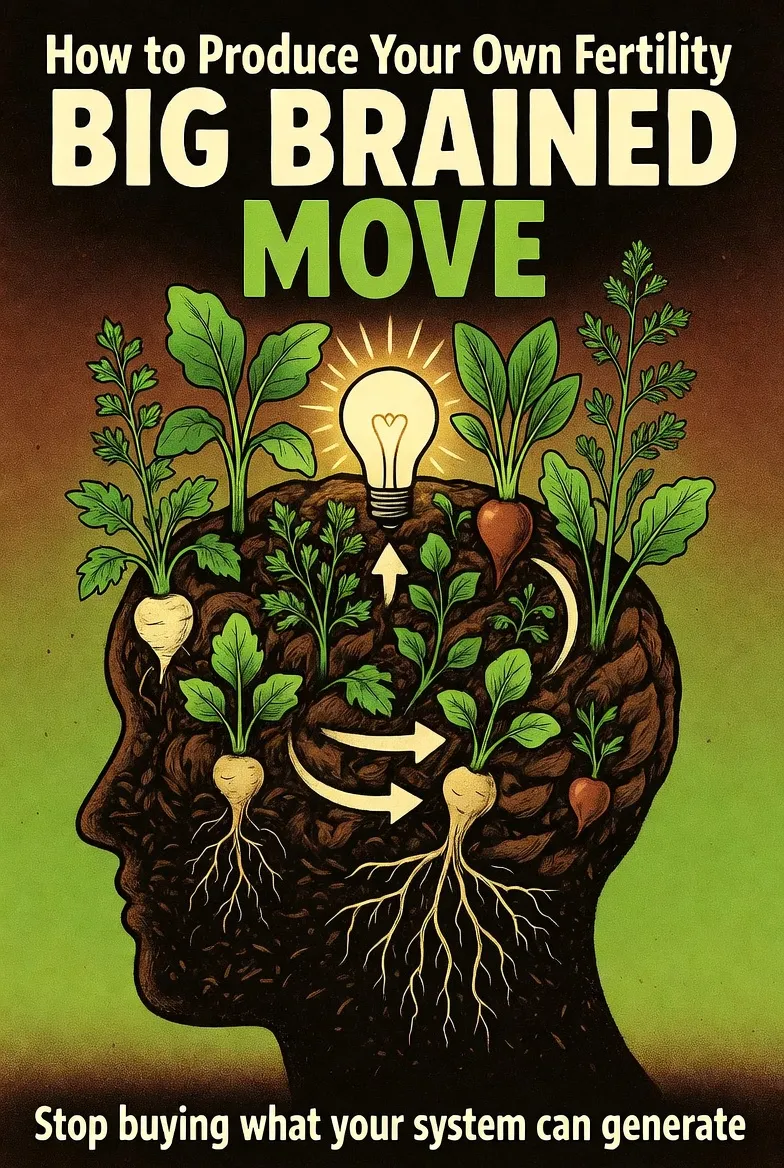
If fertilizer is something you have to keep buying, it’s not solving the problem. It’s maintaining it.
Most fertility already exists on-site — in leaves, clippings, food scraps, and plant biomass. The difference isn’t access. It’s whether that fertility is kept, or thrown away.
What “Fertility” Actually Means
Fertility isn’t just nutrients. It’s nutrients, biology, and soil structure working together.
Most store-bought fertilizers deliver nutrients. They do not build the system that stores, cycles, and delivers those nutrients over time. That system has to be built.
The Goal: Produce, Don’t Purchase
A functioning soil system does three things: it stores nutrients, cycles them continuously, and releases them when plants need them. You don’t need to manufacture this — you just need to stop interrupting it.
The Three Easiest Ways to Start
You don’t need a perfect system. You need a simple one that runs.
1. Compost
Compost is just controlled decomposition. Food scraps, leaves, yard waste — pile it, let it break down, return it to soil. That’s the system.
You can turn it, water it, and optimize it, but none of that is required. Perfect compost is unnecessary. Decomposition is inevitable.
2. Chop-and-Drop
Instead of importing nutrients, grow them. Plants pull nutrients from soil, air, and deep layers — when you cut them and leave them in place, those nutrients stay in your system.
Common choices include comfrey, legumes, and fast-growing biomass plants like tithonia. Cut them, drop them, let them decompose. If it grows on-site, it belongs on-site.
Note on Tithonia (Mexican Sunflower): Tithonia is extremely productive for biomass and breaks down fast with high nutrient content. However, fresh material can be mildly allelopathic and may stress young or sensitive plants if applied directly. Use it around established plants, as a weed-suppressing mulch, or after partial decomposition.
3. Compost Tea
If compost is your base, compost tea is your accelerator. Steep compost in water for 24–48 hours and apply it to soil. This delivers microbes and soluble nutrients in a form you can move around the system quickly — biology on demand.
Free Fertility You’re Probably Throwing Away
Most people don’t lack inputs. They remove them.
Leaves are one of the best soil-building materials available — abundant, seasonal, and free. Use them as mulch, as a compost input, or as direct soil cover.
Yard waste bins are exported fertility. Look around your neighborhood — bags of leaves, grass clippings, and plant trimmings are often sitting at the curb, free for the taking.
Arborist wood chips are one of the most underutilized resources available. Tree crews remove biomass daily and you can often get large loads delivered free through chip drop services or by asking local arborists directly. Wood chips protect soil, retain moisture, feed fungal networks, and break down slowly over time. This is not waste — it’s infrastructure.
Kitchen waste — vegetable scraps, coffee grounds, eggshells — is nutrient-dense material that typically gets discarded. Compost it and return it to soil.
Sheet Mulching: Stacking Fertility Fast
If you want to accelerate everything, layer organic matter directly onto soil. A basic sheet mulch stack — cardboard as a weed barrier, then leaves, then compost, then wood chips — suppresses weeds, builds soil, retains moisture, and feeds biology simultaneously. It’s one of the fastest ways to convert dead space into productive ground.
Time vs. Money
There is a tradeoff, and it’s worth being honest about it.
Buying fertility is fast and consistent, but it carries a recurring cost and produces no accumulation. Producing fertility has a slower start and uses available materials, but it compounds over time and reduces future inputs.
The difference is not effort. It’s where the effort goes.
What Changes Over Time
Once you start retaining and producing fertility, soil holds more water, nutrient availability stabilizes, and plant stress decreases. Pest pressure often drops too — not because pests disappear, but because the system becomes harder to exploit.
Start Here
If you do nothing else: stop removing leaves, pile organic matter, and return it to soil. That alone begins the shift.
Fertility is not something you apply. It’s something your system produces.
If nutrients leave your yard, you lost them. If organic matter returns to your soil, you keep them.
You don’t need better fertilizer. You need a system that doesn’t run out of it.