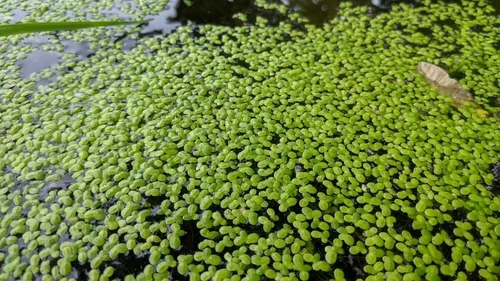
Duckweed (Lemnaceae): A High-Efficiency System for Water Remediation and Sustainable Biomass Production
Duckweed (family Lemnaceae) represents one of the most efficient naturally occurring systems for nutrient capture, water purification, and rapid biomass production. With growth rates among the fastest in the plant kingdom and protein content comparable to conventional feed crops, duckweed has been widely studied for applications in wastewater treatment, animal feed supplementation, and sustainable food systems.
Introduction
Duckweed refers to a group of small, free-floating aquatic plants found globally in freshwater environments. Species such as Lemna minor, Spirodela polyrhiza, and Wolffia spp. are among the most commonly studied. Despite its classification as a nuisance in many managed water systems, duckweed has been extensively researched for its ability to remove excess nutrients from water, produce high-protein biomass rapidly, and integrate into closed-loop agricultural systems (Skillicorn et al., 1993; Cheng & Stomp, 2009).
Its dual role as both a biofilter and a biomass generator makes it uniquely valuable in sustainable design.
Growth Characteristics and Productivity
Duckweed is one of the fastest-growing angiosperms, with a doubling time of 24–48 hours under optimal conditions and biomass yields of up to 10–30 tons dry weight per hectare per year in controlled systems.
Unlike terrestrial crops, duckweed requires no soil, has minimal lignin content, and allocates energy efficiently toward growth rather than structural tissue. The result is exceptionally high productivity per unit area.
Nutrient Uptake and Water Remediation
Nitrogen and Phosphorus Removal
Duckweed effectively removes dissolved nutrients — particularly ammonium, nitrate, and phosphorus — by assimilating them directly into plant tissue. Waste stabilization ponds using duckweed have demonstrated up to 80–90% nitrogen removal and 70–90% phosphorus reduction depending on system design and loading rates (Mohedano et al., 2012; Vermaat & Hanif, 1998).
This makes duckweed highly effective for:
- Agricultural runoff mitigation
- Municipal wastewater polishing
- Aquaculture effluent treatment
Heavy Metal Uptake
Lemna minor has been used in controlled studies to remove significant concentrations of heavy metals — including lead, cadmium, arsenic, and mercury — from contaminated water, making it useful in industrial wastewater treatment contexts (with proper biomass disposal).
Algal Bloom Suppression
By rapidly absorbing nutrients and covering the water surface, duckweed competes directly with algae, reduces light penetration, and limits overgrowth. This can help prevent eutrophication, oxygen depletion events, and harmful algal blooms.
Nutrient Recovery and Use as Fertilizer
Beyond nutrient removal, duckweed serves as an effective mechanism for nutrient recovery and reuse. The nitrogen and phosphorus absorbed during growth are stored in plant biomass and can be reintroduced into terrestrial systems in several ways.
Direct Application (Green Manure)
Fresh or dried duckweed can be applied directly to soil as a green manure. Its low lignin content means rapid decomposition and fast nutrient release — particularly nitrogen. Typical dry-weight nutrient profile:
- Nitrogen: ~3–6%
- Phosphorus: ~1–2%
- Potassium: variable
This is comparable to many conventional green manure crops, but with significantly faster production rates.
Compost Integration
Duckweed acts as a nitrogen-rich “green” input in compost systems, accelerating decomposition when combined with carbon materials like leaves or wood chips. Its soft tissue structure breaks down quickly and drives microbial activity early in the composting process.
Liquid Fertilizer
Duckweed biomass can be processed into fermented plant extracts, compost teas, or anaerobic digester inputs. These preparations deliver readily available nutrients as foliar sprays or soil drenches and support microbial life in soil systems.
Closed-Loop Nutrient Cycling
Duckweed enables a true closed-loop approach to fertility:
- Nutrient-rich water (waste stream) feeds duckweed growth
- Duckweed is harvested and applied to soil or compost
- Nutrients re-enter plant production systems
This reduces nutrient loss to waterways, dependence on synthetic fertilizers, and overall system inefficiency.
A note on contamination: Duckweed grown in polluted water (e.g., heavy metals, industrial waste) should not be used for food or fertilizer without testing. Due to rapid nutrient release, excessive application may also lead to nitrogen leaching.
Biomass Composition and Nutritional Value
Duckweed biomass typically contains 20–45% protein by dry weight, with an essential amino acid profile often comparable to soybean meal (Appenroth et al., 2017). It is also rich in lipids (~5–10%), vitamins A and B complex, and minerals including iron and calcium.
Certain species — particularly Wolffia — are already consumed as food in Southeast Asia.
Applications in Animal Feed
Duckweed has been successfully incorporated into multiple production systems:
- Aquaculture: Tilapia and carp readily consume duckweed; studies report 20–40% replacement of commercial feed without significant growth loss.
- Poultry: Chickens show a strong preference for fresh duckweed; it can partially replace soybean meal and is associated with improved yolk pigmentation and reduced feed costs.
- Livestock: Used as a protein supplement in pig diets, requiring balancing for moisture content and fiber levels.
Integration into Agricultural Systems
Duckweed performs best when embedded into closed-loop systems. The most productive configurations include:
- Wastewater + biomass production: Nutrient-rich wastewater → duckweed growth → biomass harvest → feed or compost
- Aquaponics and polyculture: Fish waste → duckweed → fish feed (partial loop closure)
- Small-scale farming: Low-cost supplemental protein with minimal infrastructure
Limitations and Considerations
Despite its advantages, duckweed systems require active management. Key challenges include:
- Overgrowth: Unmanaged mats can reduce oxygen levels in the water column.
- Contamination risk: Biomass intended for feed must be free of heavy metals or toxins.
- Climate sensitivity: Growth slows significantly in colder temperatures.
- Perception: Often viewed as undesirable or a sign of water quality problems.
These challenges are manageable with proper system design and oversight.
Conclusion
Duckweed represents a highly efficient biological system capable of addressing multiple challenges simultaneously — water purification, nutrient recovery, and sustainable protein production. Its ability to convert waste streams into valuable biomass with minimal input positions it as a strong candidate for integration into future agricultural and environmental systems.
While often overlooked or actively removed in conventional water management, existing research and real-world applications demonstrate that duckweed is not merely a byproduct of nutrient-rich environments — it is a functional solution within them.
References
- Landolt, E., & Kandeler, R. (1987). The Family of Lemnaceae – A Monographic Study. Vol. 2.
- Ziegler, P., et al. (2015). Relative in vitro growth rates of duckweeds (Lemnaceae). Plant Biology, 17(S1), 33–41.
- Cheng, J., & Stomp, A. M. (2009). Growing duckweed to recover nutrients from wastewaters. Clean – Soil, Air, Water, 37(1), 17–26.
- Zhao, Y., et al. (2014). Potential of duckweed in the conversion of wastewater nutrients to valuable biomass. Bioresource Technology, 163, 82–90.
- Culley, D. D., et al. (1981). Production, chemical quality, and use of duckweed in aquaculture, waste management, and animal feeds. Journal of the World Mariculture Society, 12(2), 27–49.
- Skillicorn, P., Spira, W., & Journey, W. (1993). Duckweed Aquaculture: A New Aquatic Farming System for Developing Countries. World Bank.
- Leng, R. A., Stambolie, J. H., & Bell, R. (1995). Duckweed – a potential high-protein feed resource. Livestock Research for Rural Development, 7(1).
- Appenroth, K. J., et al. (2017). Nutritional value of duckweeds (Lemnaceae) as human food. Food Chemistry, 217, 266–273.
- Vermaat, J. E., & Hanif, M. K. (1998). Performance of common duckweed species in nutrient removal from wastewater. Water Research, 32(9), 2569–2576.
- Mohedano, R. A., et al. (2012). High nutrient removal rate from swine wastes and protein biomass production by full-scale duckweed ponds. Bioresource Technology, 112, 98–104.