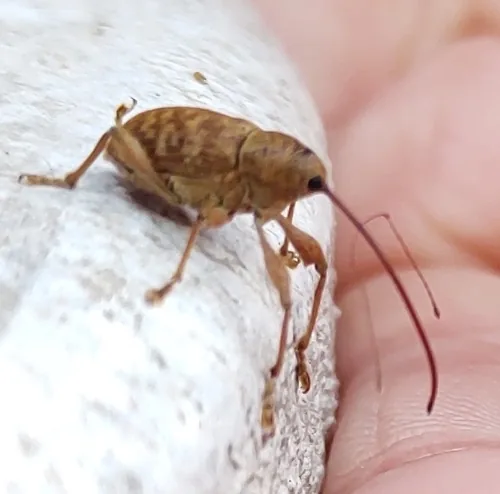
Field Identification
If plants are wilting, notching at the edges, or fruit and roots show hidden feeding damage, pecan weevil may be the cause. Adults chew above ground while larvae often feed out of sight inside soil, stems, or fruit. Damage builds quietly, then plants crash fast when roots are heavily hit. Act early so a small weevil problem does not become a season-long infestation.
Look for small beetles with a hard body and a distinct snout, usually active at dawn, dusk, or night. Check for crescent-shaped leaf notches, punctures in fruit, or tiny entry holes near stems. In soil or damaged tissue, larvae are often pale, legless, and curved in a C-shape. Fresh chew marks plus snout beetles or C-shaped grubs confirm active weevil pressure.
Not sure what you have? Use the symptom diagnosis tool →
How to Deal With It
Organic Control Methods
Steinernema carpocapsae and S. riobrave nematodes infect pecan weevil larvae and pupae in soil when applications hit moist soil under the canopy during larval drop -- timing beats chemistry in organic blocks. Beauveria and Metarhizium fungi infect crawling larvae when humidity stays high. Chickens or guinea fowl under trees scratch larvae where local rules allow; they are not precision tools.
Circle traps on trunks catch climbing adults for trend lines -- rising catches mean tighten harvest and ground treatments. Track degree-days for emergence so you are not guessing every July. Harvest as soon as nuts mature; nuts on the ground are weevil condos. Map orchards with history and scout those rows first.
Shake or pole adults onto sheets in July and August evenings before they lay in new nuts. Destroy infested nuts and shred husks promptly. Maintain bare soil or short sod under trees during emergence so nematodes contact larvae instead of thatch. Avoid heavy mulch volcanoes against trunks.
Sticky trunk bands catch some crawlers but adults fly -- focus on ground sanitation and traps. Vacuum fallen nuts before larvae crawl away. For backyard trees, pick nuts early and remove husks daily during weevil weeks.
Nematode drenches target soil stages, not adults inside nuts -- apply after irrigation when soil stays moist for forty-eight hours. Fungal products need moisture and contact; repeat after rain per label. Kaolin on foliage may deter feeding adults in some programs; read walnut and pecan labels. Organic management pairs nematodes with harvest timing, not hope alone.
Let Nature Handle It
Natural Enemies
- Entomopathogenic Nematodes
- Entomopathogenic Fungi
- Ground Beetles (Carabidae)
Threat Map