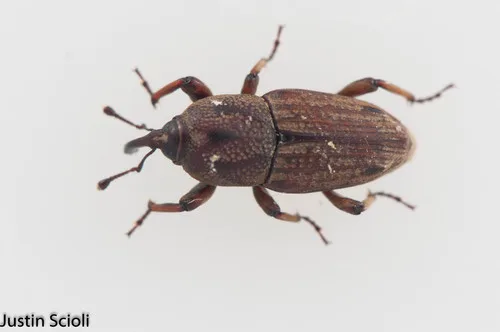
Field Identification
Billbugs are weevils whose legless grubs tunnel inside grass stems and crowns, causing scattered dead patches that resemble drought or pet urine spots. Adults notch leaf blades with their snouts in spring before laying eggs in sheaths. Damage peaks in warm months when larvae hollow stolons. They occur on turf and some pasture grasses across much of North America and similar temperate grass regions.
Pull stems from the edge of a dead patch and split them lengthwise to find sawdust-like frass and creamy C-shaped grubs without legs. Adult billbugs are dark gray to black weevils about the size of a grain of rice and walk slowly when disturbed. Billbug injury is more localized than chinch bug feeding and lacks the purple-yellow margin pattern chinch sometimes shows. Soap flushes can bring larvae to the surface for counting.
Not sure what you have? Use the symptom diagnosis tool →
How to Deal With It
Organic Control Methods
Ground beetles (Carabidae) and rove beetles consume billbug adults and larvae at soil level. Parasitic wasps attack billbug larvae in some regions, though levels fluctuate year to year. Endophytic turf grasses containing fungal symbionts deter feeding by some billbug species -- choose certified seed with appropriate endophyte viability. Avoid broad-spectrum lawn insecticides that crash predator populations before you confirm billbugs are the actual problem.
Overseed thin areas in fall so turf density excludes egg-laying females from reaching crowns easily. Avoid excessive nitrogen in early spring that pushes lush growth billbugs prefer. Irrigate deeply but less often to encourage deep roots that tolerate localized crown injury. Rotate renovation plans if one cultivar chronically fails while neighbors on different grass types stay green.
Raise mowing height during peak adult activity so crowns are less exposed to heat stress on top of injury. Aerate compacted soils so roots recover faster after grub feeding. Topdress thin spots with thin compost layers after overseeding to improve germination. Remove excessive thatch that harbors moist microsites larvae favor.
Solarizing small lawn patches can reduce grub loads before reseeding, though it kills turf too. Hand picking adults from sidewalks at night with a flashlight is oddly effective on tiny lawns. Vacuuming adults off patios after a flight event is a niche tactic but reduces local egg load. For new sod, inspect the underside for notched leaves before installation.
Entomopathogenic nematodes (Steinernema and Heterorhabditis spp.) applied when soil is warm and moist can infect billbug larvae -- follow label rates and irrigate immediately after application. Beauveria bassiana soil drenches help in some trials when repeated. Neem-based products have mixed evidence on weevil larvae inside stems but may deter adults when applied to foliage before egg laying. Always verify product labels for turf use in your jurisdiction.
Let Nature Handle It
Natural Enemies
- Ground Beetles
- Parasitic Wasps
- Predatory Beetles