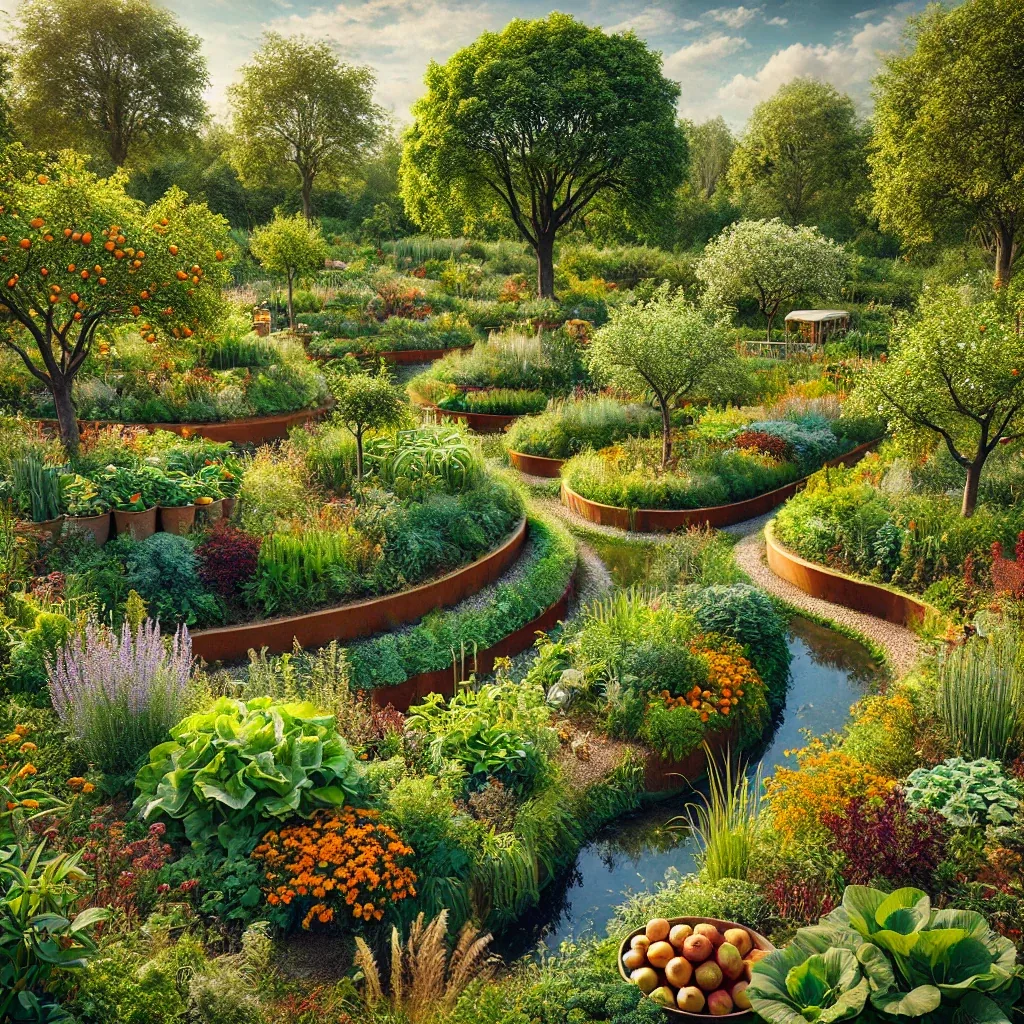
Unlocking Nature’s Blueprint: Bill Mollison’s Revolutionary Permaculture Secrets
A Philosophy Rooted in Ethics
At its heart, permaculture rests on three ethics: care for the land, care for people, and care for the future. These aren’t abstract—they’re the operating system for designing living systems that regenerate rather than deplete.
Mollison framed permaculture as a social framework as much as an agricultural one. He drew on examples like Indigenous fire management and cultures organized around keystone species (e.g., walnuts, bamboo) to show how design and culture co-evolve.
“A final ethic that we practice in our community in Tasmania is that we divest ourselves of everything surplus to our needs.” — Bill Mollison
Secrets Hidden in Plain Sight
Permaculture is less about rigid rules and more about reading signals.
- Pests as indicators. Outbreaks (stick insects, sap feeders, etc.) point to underlying problems—monoculture, poor soil, missing predators—rather than being “the” problem.
- Weeds as messages. Dock, dandelion, and friends often flag compaction or nutrient imbalance. Ask: What is the land telling me?
- Energy flows. Wind/water have patterns; study them first, then place trees, homes, and water stores accordingly.
- “The drunken walk.” Wander the site in a meandering way to feel subtle shifts in moisture, slope, soil, and vegetation before fixing lines on a map.
- Curves over straight lines. River bends, root networks, animal paths are irregular for a reason. Curved beds, meanders, and non-orthogonal ponds move energy gently and efficiently.
Mastering the Flow of Life: Water and Soil
Imagine a landscape where every drop is guided with purpose—captured, slowed, stored, and used multiple times.
Beyond Swales: Water Retention Patterns
- Contour dams & interlinked ponds. Multiple small stores at different elevations enable gravity-fed irrigation and redundancy.
- Chain of ponds. Staggered pools linked by narrow channels slow floods, boost habitat, and reduce erosion.
- “Hidden water.” Read dark green patches and other cues to locate subsurface moisture for strategic planting.
- Below-garden gley. Organic layers beneath beds act like a shallow aquifer, cutting irrigation needs.
- Earth banks for flood control. Low berms redirect pulses into storage instead of exporting topsoil.
Restoring Soil: The Foundation of Regeneration
Soil is the Earth’s living skin. Degradation is reversible if we design for biology.
Soil strategies
- Compost without bins. Sheet composting mimics forest litter cycles.
- Mulch over rocks. In arid zones, mulch + stone mass trap moisture and build soil in place.
- Pioneer plants. Deep-rooted species (acacia, pigeon pea, tagasaste) mine minerals and kickstart fertility.
- Animal integration. Chickens, pigs, and ruminants aerate, cycle nutrients, and reduce mechanical tillage.
- Fungal allies. Logs, woody debris, and mycorrhizae revive compacted or “dead” soils.
Did You Know? Uncommon Mollison Insights
- Invisible structures. 80% of permaculture is social: CSAs, barter/co-ops, and community land trusts make ecological design durable.
- Bunyip level. A low-tech water-leveling tool (historically gut-and-tube) for setting contours—still powerful and accessible.
- Mulch on rock. Rocks store heat, protect roots, and catch organic fines for fertility islands.
- Fire as a design tool. Fire-safe plantings, water bodies, moist windbreaks, and strategic cool burns to prevent catastrophic fires.
- “Millionaire’s permaculture.” Self-reliant estates: food forests, natural pools that double as fish ponds, on-site water/energy.
- Underground climate control. Walipini greenhouses, earth-bermed homes, stone thermal mass to buffer heat/frost.
- Forests & oxygen. Forest integrity links to rainfall cycles; beware “green deserts” (monoculture plantations).
- Animals as functions. Ducks for slugs, chickens to process windfalls, pigs to decompact orchards.
- Edge effects. Maximize pond edges, use keyhole beds, floating islands, and meanders to multiply habitat and yield.
The Hidden Potential of Windbreaks
A windbreak can simultaneously:
- Create habitat for birds/insects/fungi
- Provide mulch via pruning
- Reduce evaporation and moderate microclimates
- Prevent erosion by cutting wind speed
Design in layers (staggered heights), and include N-fixers (acacias, pigeon pea) to build soil as the barrier matures.
Using Rocks and Logs for Microclimate Control
- Place large rocks to store daytime heat and release it at night (frost protection, season extension).
- Bury logs/woody debris to act as moisture batteries (the basis of Hügelkultur).
- Combine stone + deadwood as wind baffles and solar reflectors to favor tender crops.
Multifunctional Elements: More Than the Sum
In good design, every element serves 3+ functions.
A windbreak is shelter, habitat, and mulch source; a pond is water store, climate buffer, aquaculture, and edge habitat. Stack functions everywhere.
Unlocking Nature’s Blueprint for a Regenerative Future
Mollison’s core message: nature already shows the pattern. Read the signals, design with curves and edges, and make every piece do more than one job. Small, smart interventions—a meander here, a windbreak there, a chain of ponds—scale into resilient, abundant systems.
Sources & Acknowledgments
- Mollison, Bill. Permaculture: A Designer’s Manual. Tagari Publications, 1988.
- Mollison, Bill. Permaculture: A Practical Guide for a Sustainable Future. Ten Speed Press, 1990.