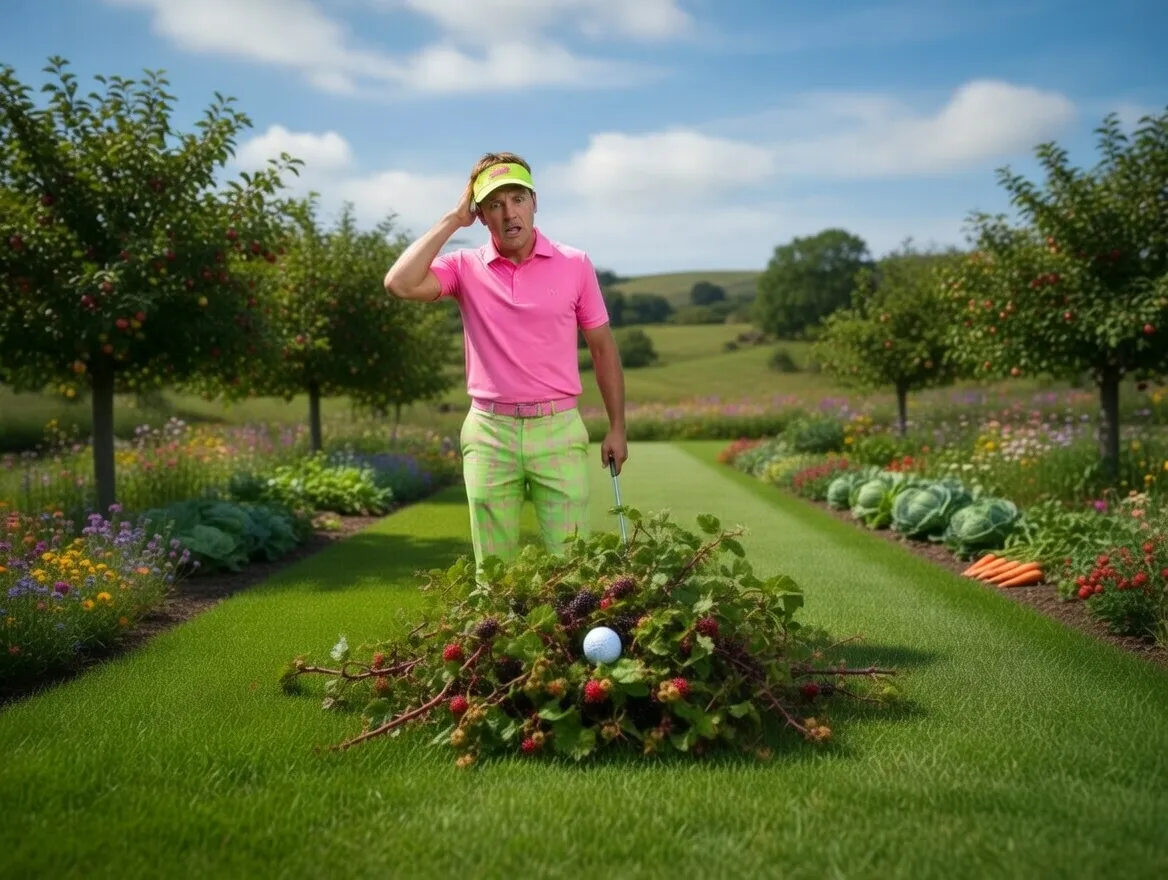
There are approximately 15,000 golf courses in the United States alone. That’s roughly three million acres of land — an area larger than Delaware and Rhode Island combined — dedicated to a game where grown men hit a tiny ball into a hole while wearing pastel pants and insisting it’s exercise.
All so a bunch of wealthy dudes can LARP as athletes in outfits that look like Easter eggs had a psychological episode.
And somehow, this is considered normal.
Golf courses are ecological disasters dressed up as prestige landscaping. They guzzle more water per acre than most agriculture, drown the soil in pesticides, and exist mainly so wealthy men can pretend they’re athletes while riding around in glorified motorized strollers.
The sport is so boring that TV producers have to hide microphones on players just to capture them whispering “nice shot, Chad.”
But what if we fixed it?
What if, instead of fighting nature, we weaponized it?
What if we turned golf courses into living, chaotic, permaculture playgrounds where the course fights back?
Welcome to Permagolf — the only version of the sport that would actually be worth watching. Where the course is no longer a backdrop. It’s an active participant.
Chapter 1: The Current Model Is Insane
A traditional golf course is a biological desert with sand traps.
It requires:
- Billions of gallons of drinking water
- Heavy applications of fertilizers and pesticides
- Constant mowing, aerating, and chemical babysitting
All so that a small ball can roll exactly where some guy in a visor wants it to.
Meanwhile, the “rough” is just slightly taller grass. A bold design choice.
Chapter 2: The Permagolf Revolution Begins
We don’t need to ban golf. We just need to stop coddling it.
Here are the only improvements that would actually make the game more mental, more fun to watch, and slightly less embarrassing for the planet:
1. Replace Fairways with Food Forests
No more boring, flat, monoculture grass. Fairways become layered permaculture systems: fruit trees, berry bushes, nitrogen-fixing legumes, and edible perennials.
Your ball lands in a blackberry thicket? That’s a hazard. Good luck explaining to your playing partners why you’re now bleeding lightly and stained purple, trying to justify how this counts as a playable lie.
Bonus: spectators get to forage during slow rounds. The snack-to-shot ratio improves dramatically.
2. Make Water Hazards Actually Alive
Turn ponds into functioning wetlands full of fish, frogs, turtles, and cattails.
Your ball goes in the water? It’s gone. There are now largemouth bass in there with strong opinions about Titleists.
Suddenly every water hazard becomes a genuine ecological event. Commentators could do live segments on the biodiversity score of each hole.
3. The Rough Becomes the Real Game
Current rough is a joke. New rough is a polyculture jungle: native grasses, wildflowers, pollinator meadows, and the occasional intentional poison ivy patch for psychological warfare.
Missing the fairway now means dealing with actual ecosystems. Want to play from the milkweed and goldenrod? Enjoy the bees. Hit it into the native blackberry bramble? That’s a one-stroke penalty and a brief conversation with your immune system.
4. Bunkers Become Hügelkultur Swales
Instead of sterile sand pits, bunkers are now raised, mulched beds growing herbs, medicinal plants, or low-maintenance perennials.
Your ball is buried in a mound of wood chips and comfrey? Congratulations — you’re now gardening mid-round whether you planned to or not. The mental game just got extremely mental.
5. Introduce Wildlife as Mobile Hazards
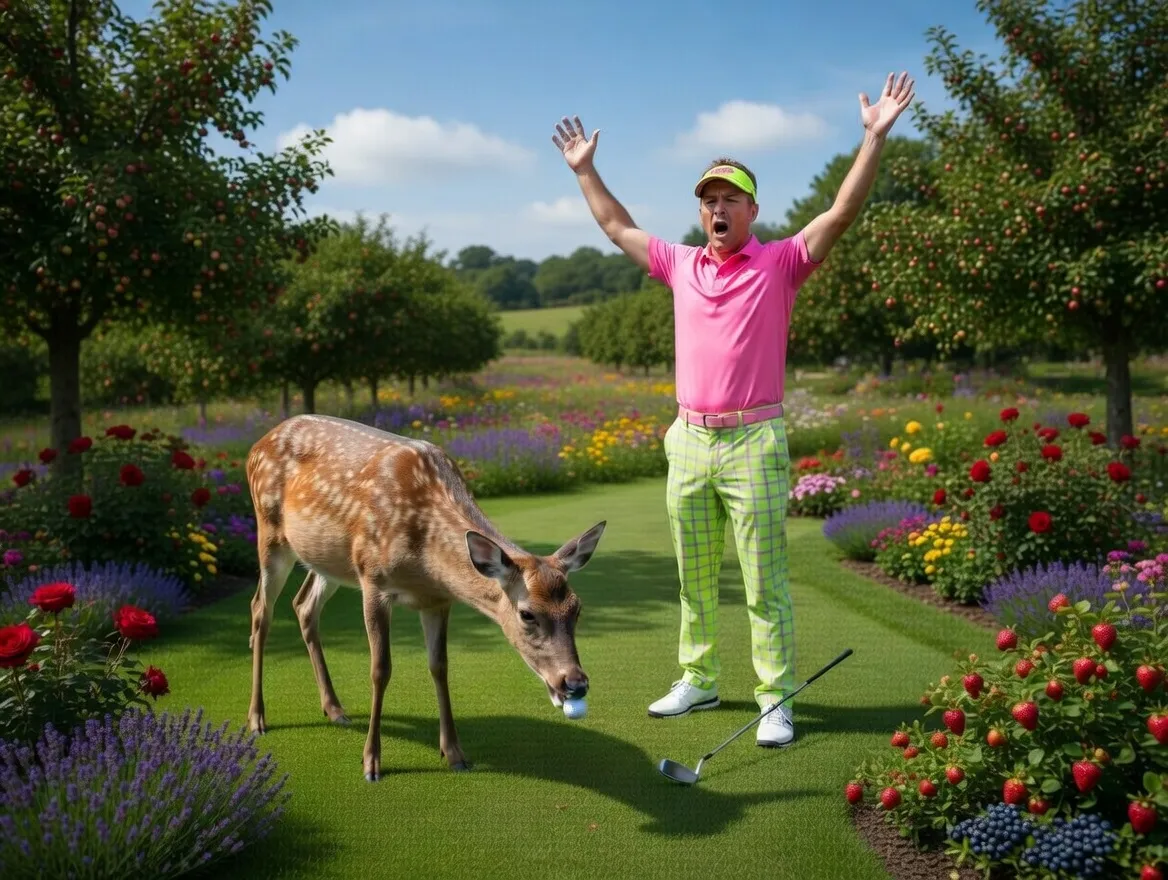
Deer, rabbits, groundhogs, and the occasional turkey flock become official course features.
A deer eats your ball? That’s nature’s way of telling you to lay up.
A fox runs off with your Titleist? Free drop… if you can negotiate with him.
6. Greens Stay Greens — But Make Them Edible
The putting surface becomes a mix of low-growing clover, creeping thyme, and microgreens.
You still putt, but now the green doubles as a salad bar. The grounds crew is replaced by a small herd of rotationally grazing sheep with no respect for tee times.
Chapter 3: The Unintended Benefits
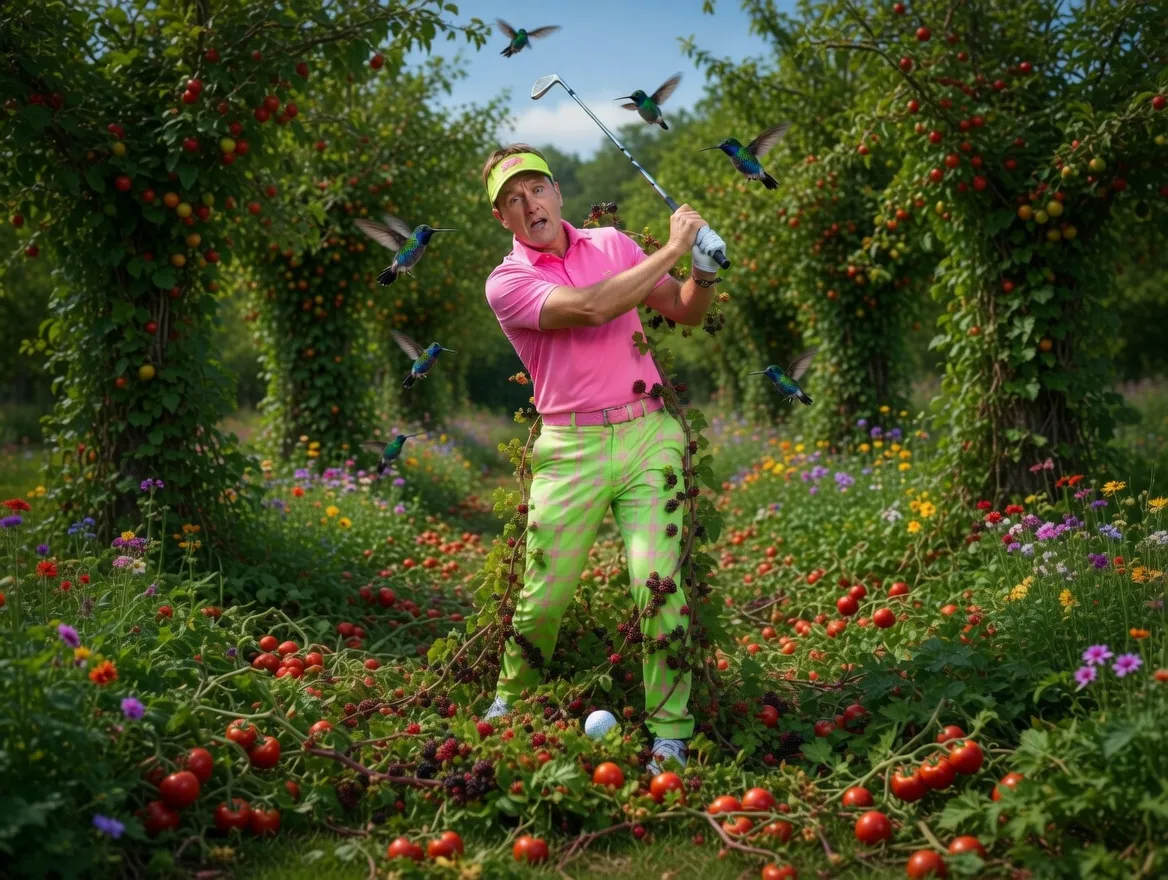 Spectator entertainment skyrockets. Watching a pro try to chip out of a mature food forest while being dive-bombed by hummingbirds is objectively better television than current golf.
Environmental impact flips from catastrophic to regenerative.
The game itself becomes harder, weirder, and more honest. No more pretending the course is a neutral playing field. The course now has opinions.
Elitism takes a hit. Nothing humbles a golfer faster than realizing his $8,000 set of clubs is currently stuck in a guelder-rose bush he definitely cannot identify.
Golf doesn’t need to die. It just needs to stop pretending this makes sense.
The current version is a status symbol pretending to be a sport on land that could be growing food, supporting wildlife, or at the very least not poisoning watersheds.
The permaculture version is still ridiculous.
But at least it would be honestly ridiculous.
And honestly ridiculous is better than whatever this currently is.