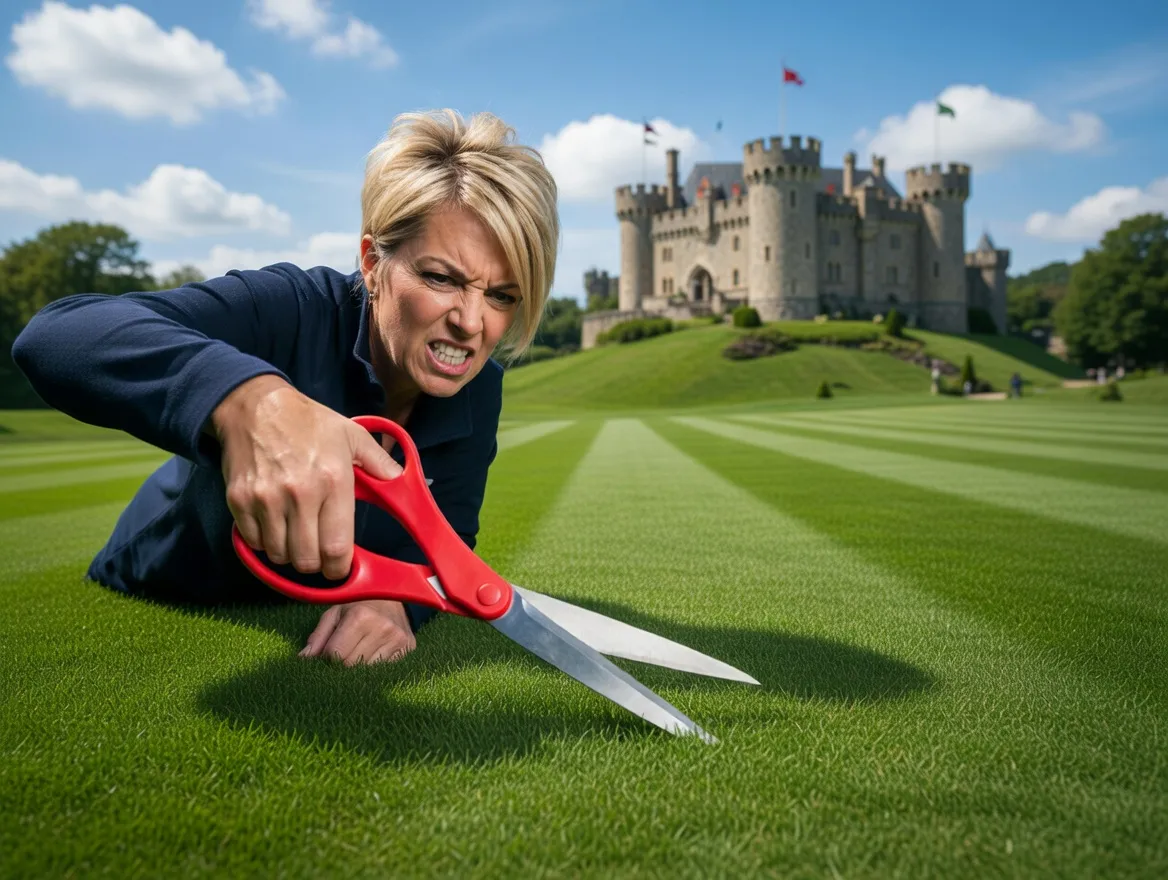
There was once a time when land had a purpose.
You grew food on it. You gathered medicine from it. You let animals graze on it. Occasionally, you even had the radical idea of leaving it alone.
Then humanity had a thought:
“What if we ripped out everything useful and replaced it with one aggressively mediocre species of plant… and then spent the rest of history defending it to the death?”
And thus, the lawn was born.
Chapter 1: The Original Flex
Lawns didn’t start as landscaping. They began as a flex.
In medieval Europe, land was survival. You used every inch — crops, livestock, herbs, whatever kept you alive. Unless you were rich.
If you were rich, you could afford the ultimate luxury: doing absolutely nothing with it. So wealthy landowners cleared the land, made sure nothing edible grew there, and kept it meticulously empty.
Nothing says “I’m better than you” like owning more land than you could ever need and choosing to waste it on purpose.
Early lawns even had one practical use: clear sightlines made it easier to spot peasants… or invading armies.
Your HOA lawn is therefore the direct descendant of both aristocratic boredom and low-tech military surveillance.
Chapter 2: Grass, But Make It Colonial
Fast forward.
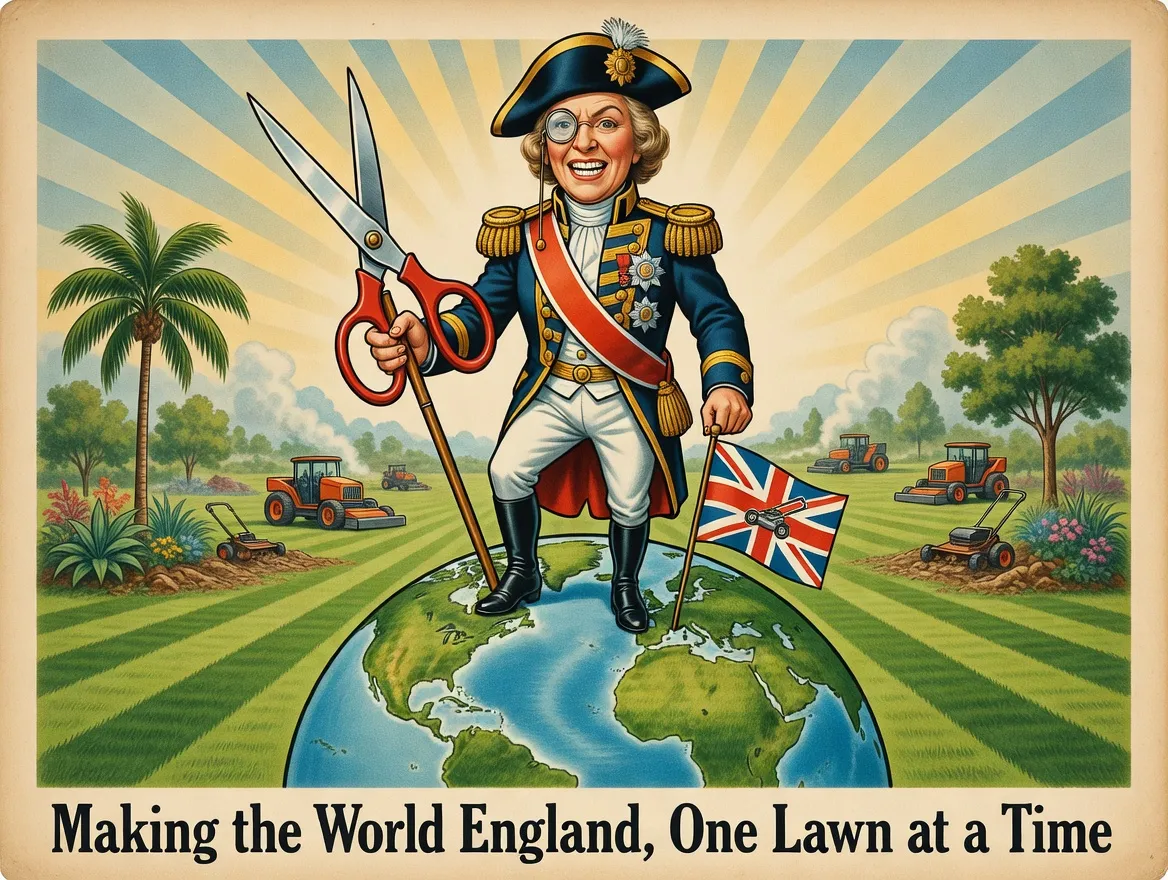
Europe discovers the rest of the world and has one collective thought: “This would look better if it looked exactly like England.”
So they exported the lawn like a biological copy-paste error. Native ecosystems? Bulldozed. Diverse food systems? Flattened into decorative emptiness. Anything that dared to grow without permission was reclassified as a “weed” and executed.
The lawn was never just landscaping. It was cultural conquest with better curb appeal.
Chapter 3: The Suburban Explosion
For centuries, lawns remained a rich man’s hobby.
Then came the 20th century and the greatest miracle in human history: the middle class. Suddenly, ordinary people could participate in the ancient aristocratic tradition of owning land and carefully ensuring it produces absolutely nothing.
After World War II, America went all-in. Lawns spread like a green plague across the suburbs — standardized, enforced, and weaponized by HOAs.
Today they cover roughly 40 million acres in the U.S. alone. That’s an area the size of Colorado dedicated to a plant that produces nothing except anxiety and property values.
At this point, grass stopped being a plant. It became a requirement. A social contract. A conformity test with chlorophyll.
Chapter 4: The Resource Sink Nobody Questions
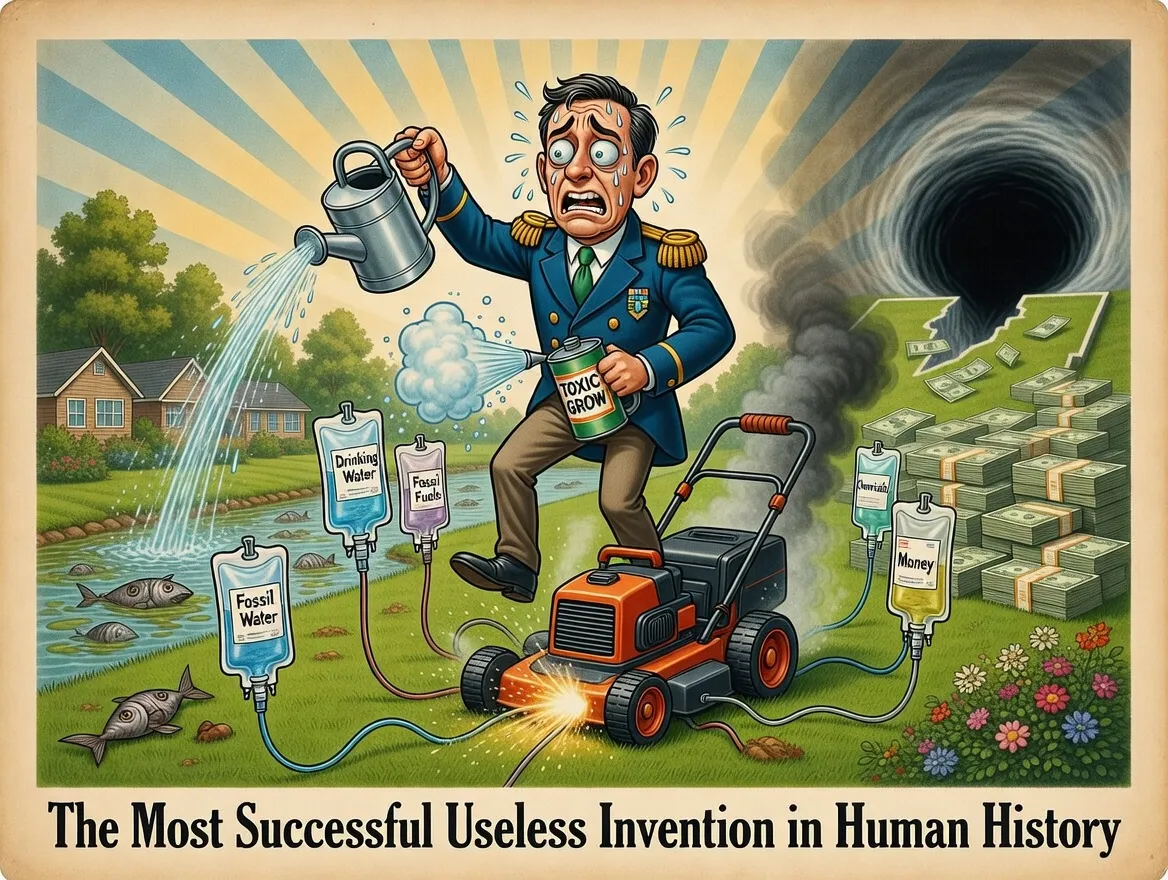 This is where the comedy becomes performance art.
To maintain this completely artificial, pointless ecosystem, we now:
- Pour billions of gallons of drinking water on it every day
- Dump fertilizers and pesticides that poison rivers and create dead zones
- Burn fossil fuels weekly just to keep it artificially short
- Remove free nutrients (leaves) and replace them with expensive store-bought chemicals
We have successfully engineered a system where the land cannot sustain itself, so we spend money to keep it alive, so it can continue doing nothing.
It is, without question, the most successful useless invention in human history.
Chapter 5: The Ecological Void
Ecologists politely describe a traditional lawn as “a biological desert.”
We took complex, living ecosystems that supported birds, insects, soil life, and intricate food webs… and replaced them with a single species of grass that is never allowed to grow taller than two inches.
Chapter 6: The Modern Lawn Enjoyer
And now we arrive at today.
The average homeowner now:
- Buys chemicals to kill plants
- Buys more chemicals to replace the nutrients they just destroyed
- Spends their Saturday pushing a noisy machine around in circles
- Then retreats inside to “relax” on furniture made from the fossil fuels they just burned
All to maintain a landscape that doesn’t feed them, doesn’t support wildlife, and costs serious money, time, and energy — but looks “clean” and “nice.”
The Weirdest Part
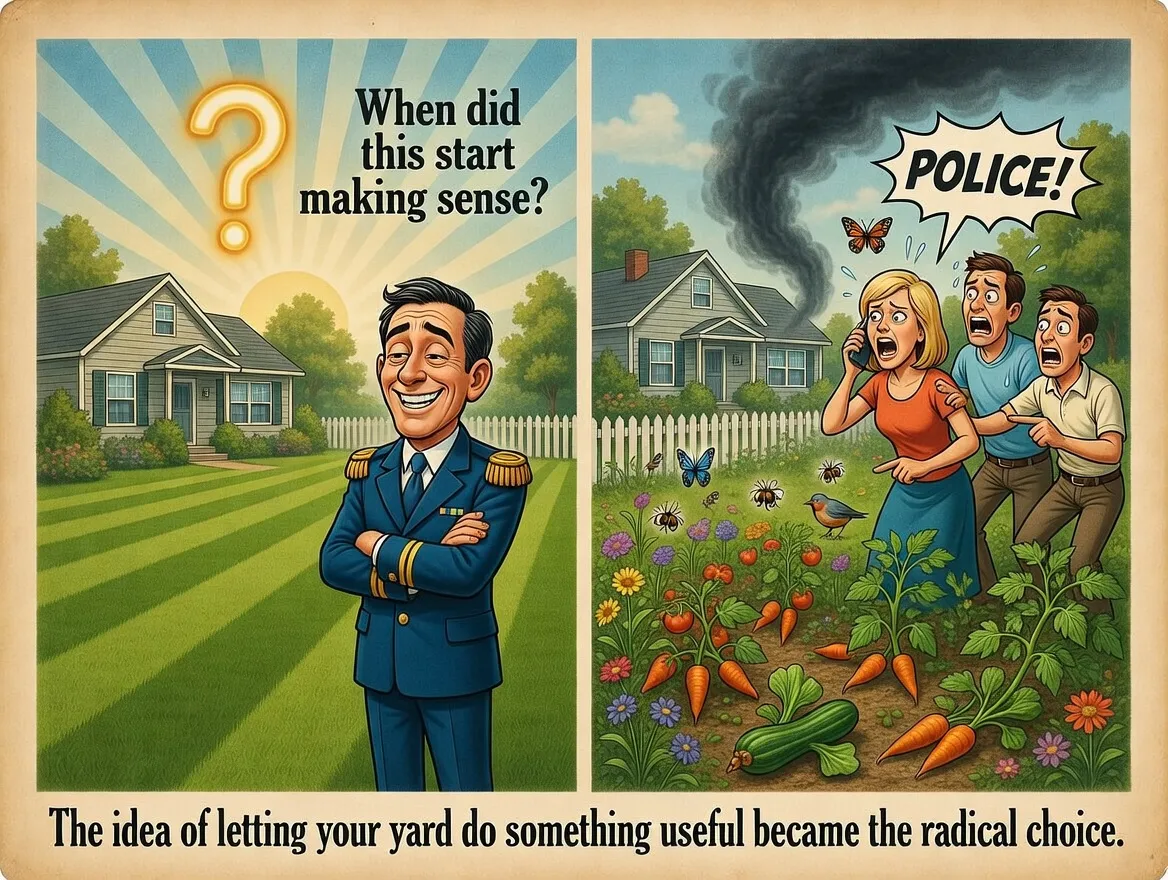 The strangest thing about lawns isn’t their ridiculous history. It’s that at no point did society ever stop and ask: “Hey… when did this start making sense?”
Instead, we doubled down. We perfected it. We regulated it. We made not having one suspicious.
Until the idea of letting your yard do something useful became the radical, antisocial choice.
The lawn is not natural. It is not efficient. It is not inevitable.
It is simply what happens when a status symbol survives long enough to become invisible — and then enforced.