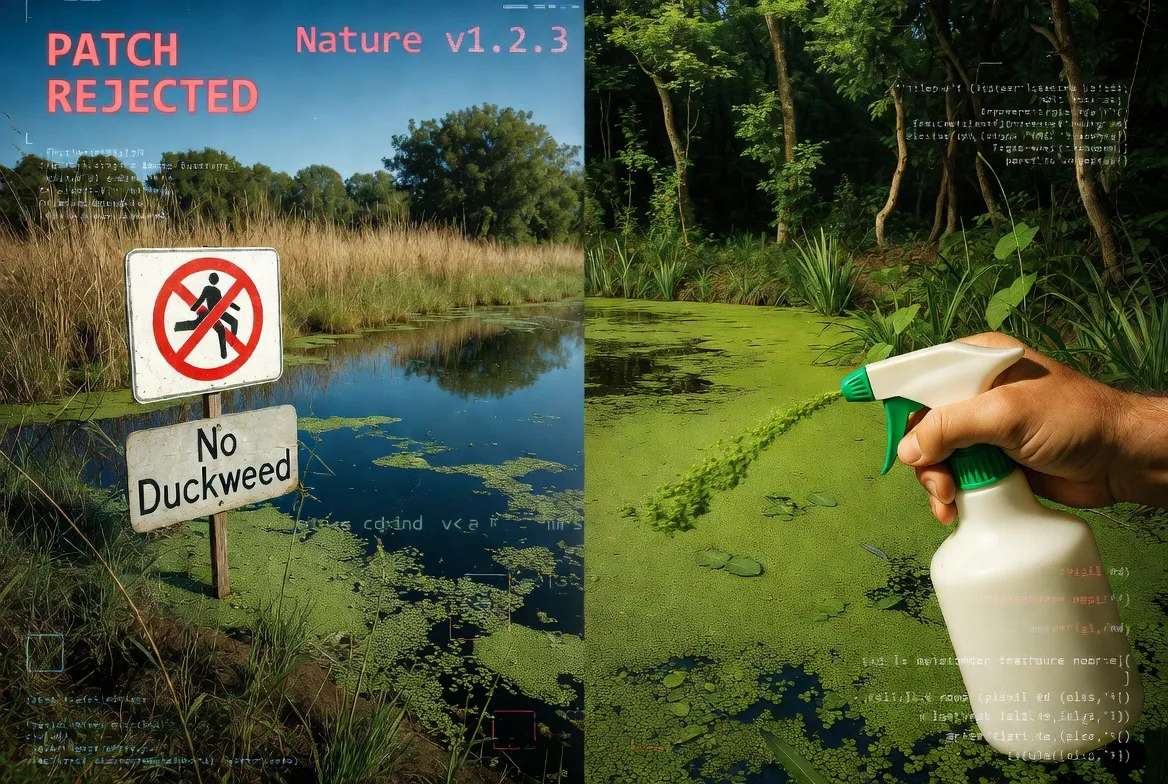
There is a certain type of problem humanity struggles with more than most.
Not scarcity. Not complexity. Not even cost.
No — our greatest challenge appears to be solutions that arrive uninvited.
Duckweed is one of those solutions. So naturally… we kill it.
The Problem With Duckweed (From Our Perspective)
Duckweed is a tiny floating plant. You’ve probably seen it — covering ponds in a bright green layer that triggers something deep within the human brain:
“That looks messy. We should destroy it.”
This is understandable. We have spent generations perfecting landscapes that resemble carpets. Order is comforting. Uniformity is control.
Duckweed offers neither. Instead, it grows. Rapidly. Under ideal conditions, it can double its biomass in as little as 24–48 hours. It does not ask permission. It does not require fertilizer schedules, irrigation systems, or quarterly planning meetings.
It simply exists — and solves problems.
Which is where things start to get uncomfortable.
Water Filtration (Unapproved Behavior)
Duckweed has a habit of removing excess nutrients from water. Nitrogen. Phosphorus. Agricultural runoff.
The very substances responsible for algae blooms, dead zones, and declining water quality — duckweed absorbs them and converts them into biomass.
Quietly. Efficiently. Repeatedly.
It can also uptake certain heavy metals, making it useful in phytoremediation systems. In wastewater environments, it acts as a living filter — polishing water in a way that is both low-tech and highly effective. In other words:
Duckweed reduces pollution.
Unfortunately, this creates a conflict.
Because in many cases, our official solution to polluted water is to introduce additional chemicals to manage the symptoms of pollution.
Duckweed interferes with that workflow. And systems rarely appreciate being outperformed by a plant.
Protein Production (Without Filing the Proper Paperwork)
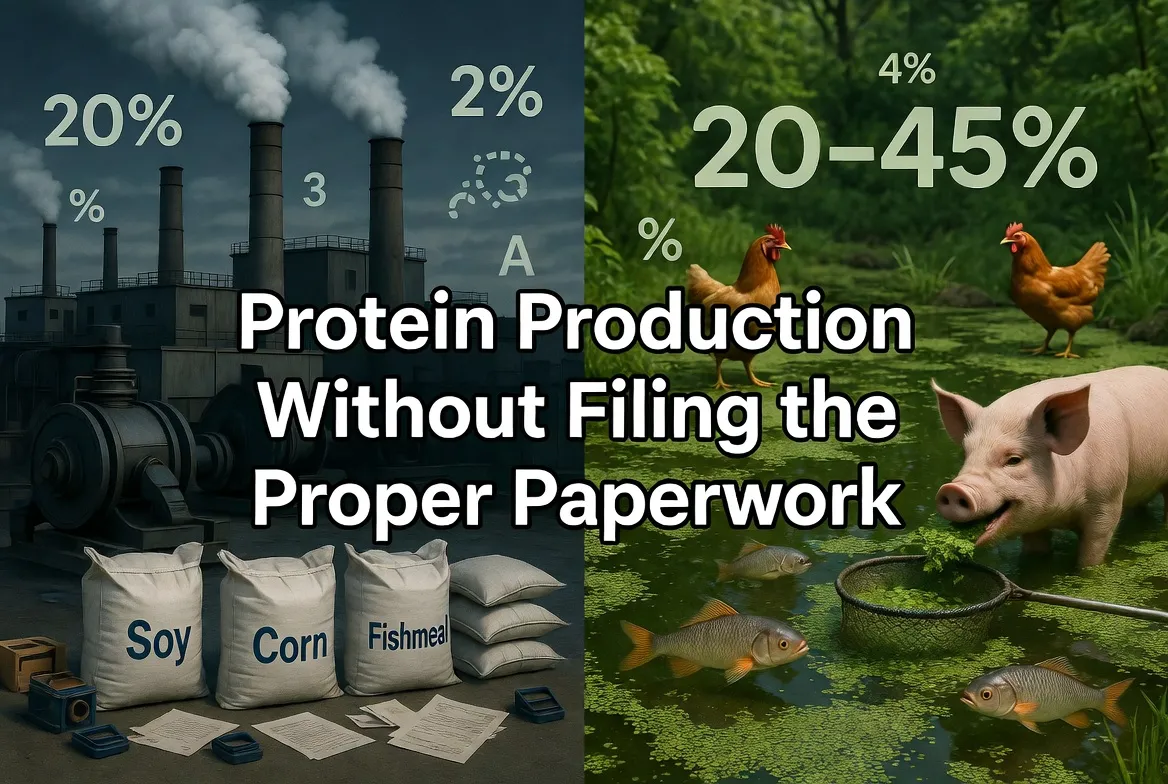 On a dry weight basis, duckweed contains between 20% and 45% protein, including essential amino acids.
This makes it:
- A viable feed source for fish
- A supplement for chickens
- A partial replacement for pig feed
- A potential human food source (though this tends to raise eyebrows until someone invents a brand around it)
It grows on nutrient-rich water. It scales itself.
There are entire industrial systems designed to produce protein using vast amounts of land, energy, and logistics.
Duckweed does something similar…
…but smaller. Faster. And without submitting a proposal.
Feed Costs (A Suspicious Reduction in Expenses)
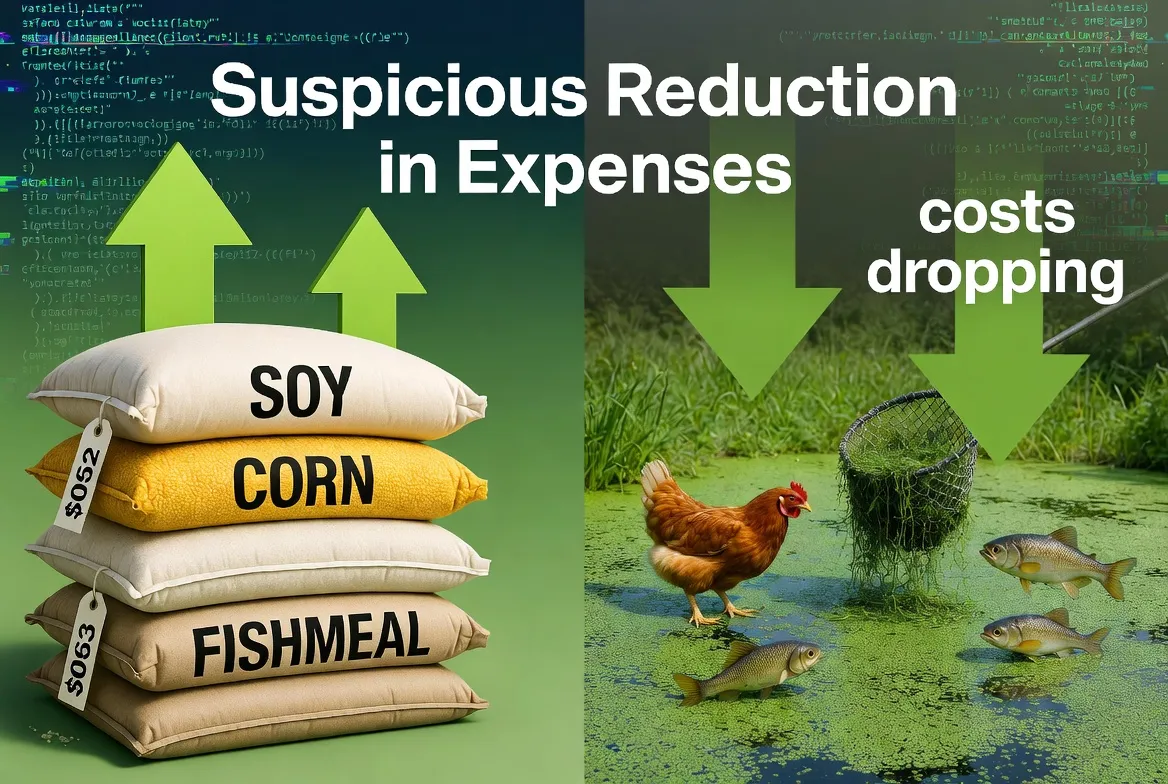
Feed is one of the largest recurring costs in animal agriculture.
Soy. Corn. Fishmeal. Inputs go in. Costs go up.
Duckweed, on the other hand, grows on waste streams — agricultural runoff, aquaculture systems, even certain forms of wastewater when managed properly.
This creates an awkward scenario: A plant that converts waste into usable protein, potentially reducing feed costs.
From a purely rational standpoint, this should be explored aggressively.
From a systems standpoint, it raises uncomfortable questions about why we aren’t already doing this everywhere.
So instead, in many cases, we classify it as a nuisance.
The Official Response: Chemical Intervention
When duckweed covers the surface of a body of water, it disrupts the aesthetic. It signals that nutrients are present. That the system is active. That something is happening outside of our control.
So we respond.
Often with herbicides.
Sometimes with compounds designed specifically to eliminate plant growth in aquatic systems.
Which leads to a fascinating loop:
- Nutrient pollution enters the water
- Duckweed grows and begins removing it
- Duckweed is killed with chemicals
- Nutrients remain
- Repeat as necessary
From a systems engineering perspective, this is elegant in its consistency. From any other perspective… it is working exactly as designed.
Error Detected: System Self-Healing
If this were a server, the logs might look something like this:
Warning: Elevated nutrient levels detected
Response: Deploy duckweed
Status:   Nutrients decreasing

Alert:    Surface no longer aesthetically pleasing
Action:   Apply herbicide
Result:   Duckweed removed
Status:   Nutrients increasing

Resolution: Pending.
Meanwhile, Unsupervised
Duckweed does not stop existing because we disapprove of it.
It continues to grow in ditches, ponds, neglected systems — anywhere nutrients accumulate and sunlight is available. It continues to:
- Capture excess fertility
- Produce usable biomass
- Support closed-loop systems
- Offer a pathway toward decentralized food production
Unpatented. Unmonetized (mostly). Uninterested in whether we approve.
Practical Uses (For Those Willing to Commit Heresy)
For anyone operating outside of strictly aesthetic priorities, duckweed is extremely useful. It can be integrated into:
- Backyard pond systems as a nutrient sink — many Florida food forest ponds use it to keep water clear and prevent algae blooms while producing free chicken feed at the same time.
- Greywater polishing setups to reduce excess nutrients — it works brilliantly after septic systems or laundry outflow before the water hits a mulch basin or garden.
- Aquaculture systems as a live feed input — tilapia, koi, and other fish devour it, often cutting commercial pellet use by 30–50% in small-scale setups.
- Chicken systems as a protein supplement — throw fresh duckweed into the run daily and watch laying hens go wild for it. High in protein and keeps them entertained.
- Permaculture designs as part of a closed-loop fertility cycle — harvest it from swales or treatment ponds and compost or feed it directly to livestock for fast nutrient cycling.
It grows itself. Harvesting is as simple as scooping with a net or bucket. The system scales naturally with nutrient availability — more waste nutrients = more free duckweed.
Most people spend money fighting duckweed. A growing number of us are harvesting it instead.
It is, in many ways, a biological shortcut.
Which may explain the resistance.
The Real Issue (It Works)
 Duckweed is not invasive in the traditional sense.
It does not destroy ecosystems. It does not poison soil. It does not require intervention to function.
What it does is expose inefficiency.
It reveals that many of our systems are not designed to work with natural processes — but to override them.
And when something shows up that works too well… …it becomes a problem.
Clarity Is Not Control
A pond covered in duckweed is often seen as unhealthy.
But in many cases, it is actively correcting an imbalance — absorbing nutrients that would otherwise fuel far more destructive outcomes, like algal blooms and oxygen depletion.
Clear water is not always healthy water.
And messy systems are not always broken.
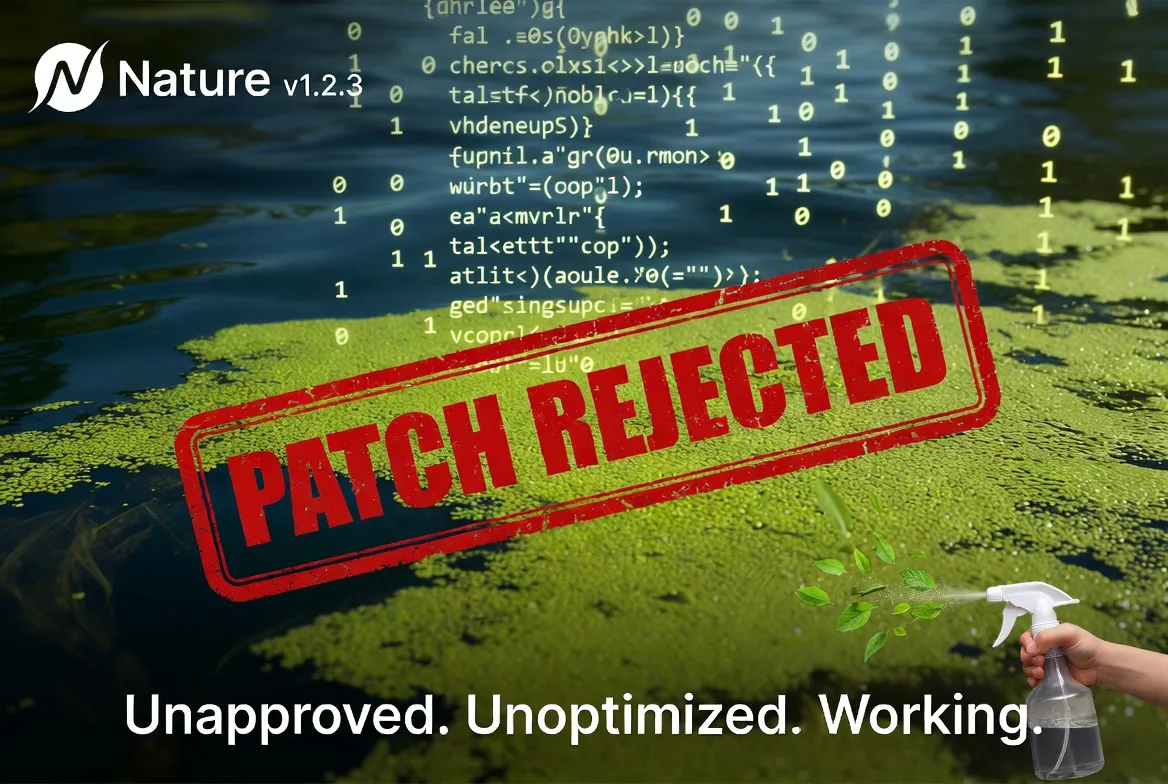
Conclusion: Patch Rejected
 Duckweed will not replace agriculture.
It will not solve every problem.
It is not a silver bullet.
But it is a functioning piece of a better system — one that offers water purification, protein production, and nutrient cycling with almost zero input.
It is a tool.
One we have, collectively, decided to treat as a bug.
Nature submitted a patch.
We reviewed it, flagged it as undesirable behavior, and deployed a chemical rollback.
Somewhere, on the surface of a still pond, the patch continues to run anyway.
Unapproved. Unoptimized. Impossible to invoice.