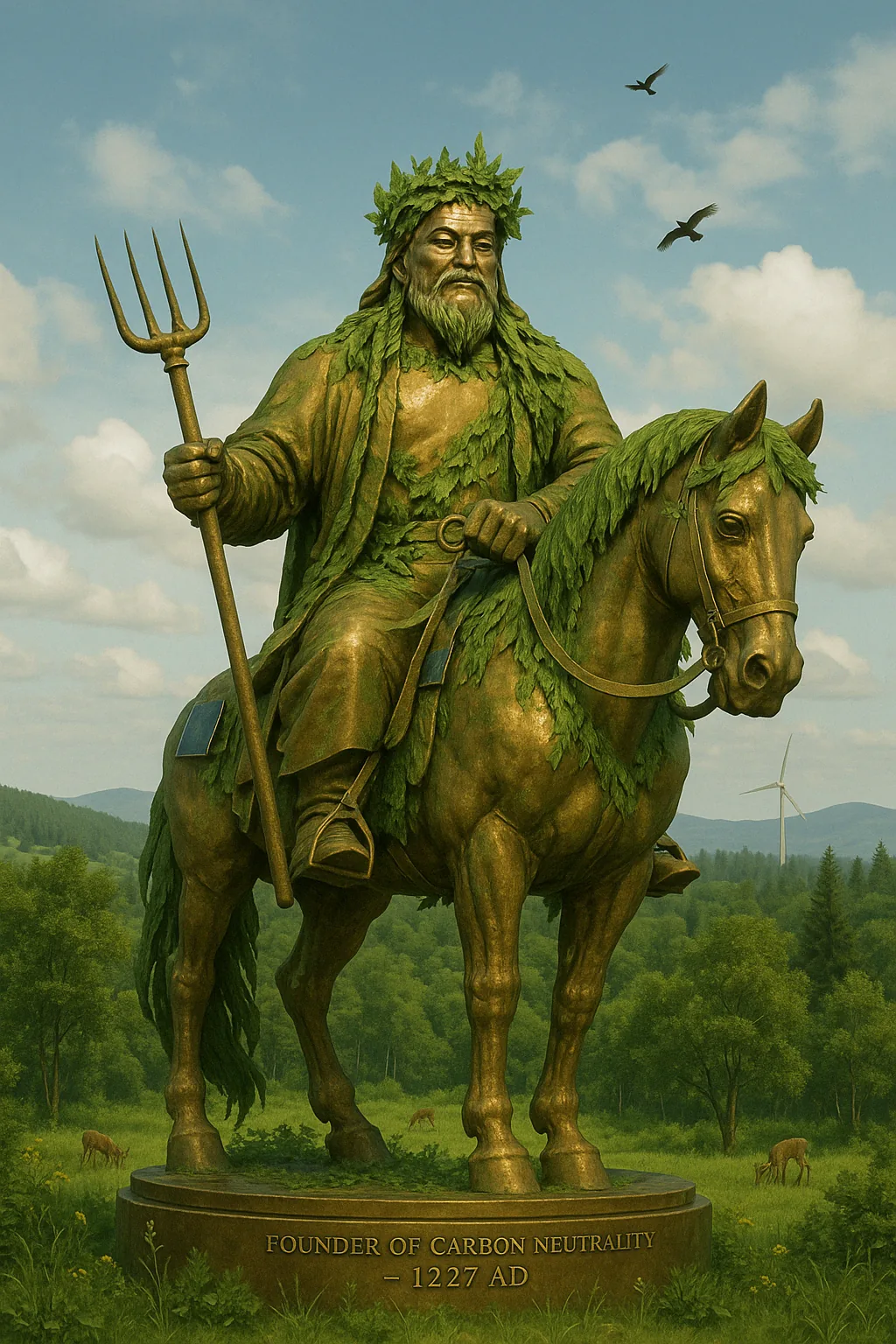
Note: Models estimate the Mongol conquests led to reforestation that pulled ~700 million tons of carbon from the atmosphere as abandoned farmland turned back into forest. (Carnegie Institution study, via ScienceDaily, 2011.)
Before Greta Thunberg glued herself to anything, there was Temüjin — known to friends and terrified enemies as Genghis Khan. While modern climate leadership convenes at altitude, the Khan delivered measurable results: nearly 700 million tons of carbon scrubbed from the sky in under a century. No summits in Bali. No reusable straws. Just carbon-neutral cavalry and a refreshingly direct approach to land-use reform.
Researchers at the Carnegie Institution confirmed it. The Mongol hordes didn’t just conquer Eurasia — they accidentally engineered one of history’s biggest rewilding events. Cities emptied. Fields went fallow. Forests marched back in. Nature, it turns out, thrives when farming stops.
Modern activists dream of “degrowth.” Genghis achieved Total Net-Zero — the old-fashioned way.
The Great Mongol Reforestation Initiative
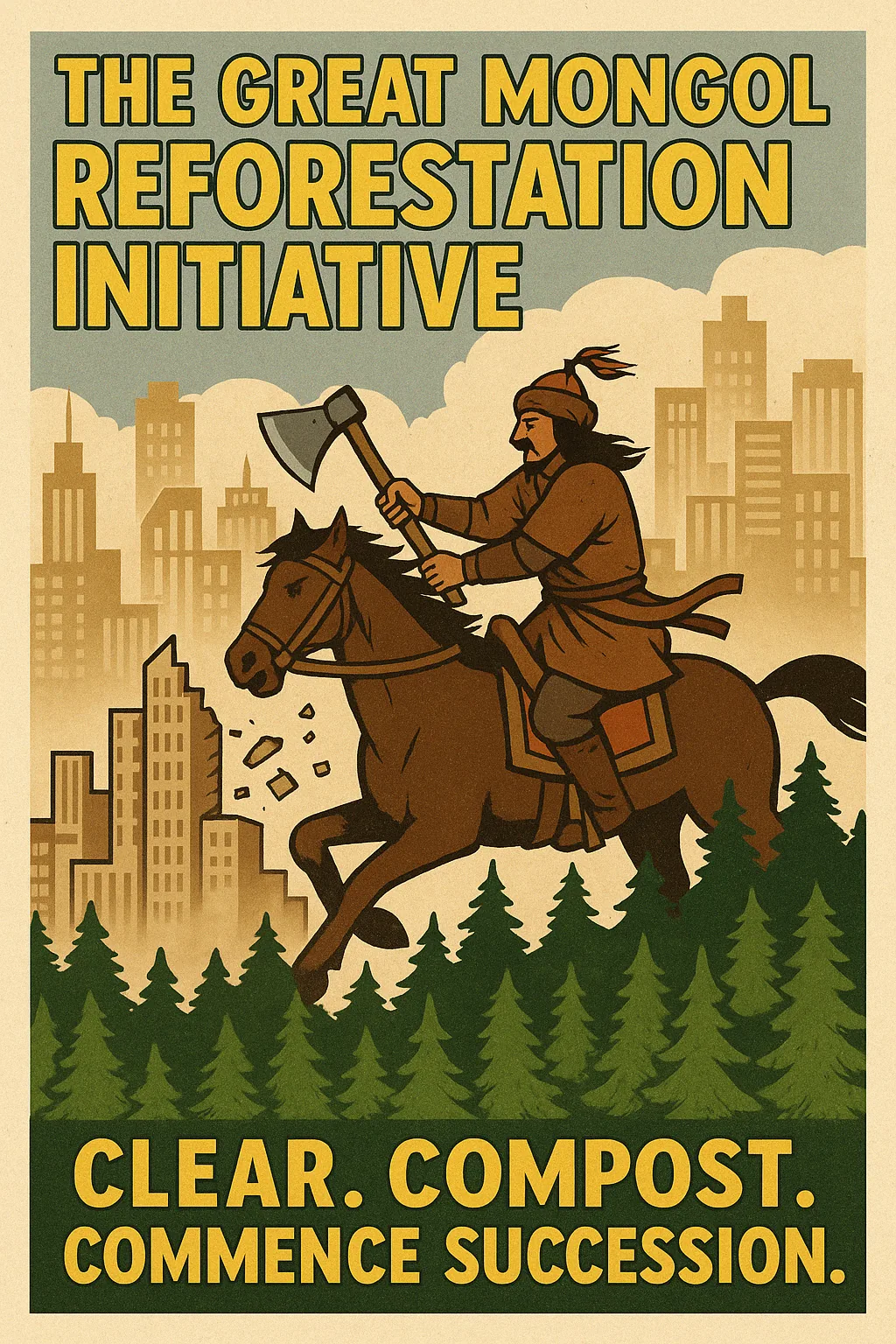
The Khan’s method was elegant in its simplicity: conquer, compost, commence ecological succession.
No bureaucratic delays. No stakeholder consultations. When a city fell out of compliance with Mongol governance, its agricultural footprint was immediately retired. Millions of acres of monoculture cropland reverted to native vegetation. Wildlife repopulated. Carbon dioxide levels dropped.
Historians sometimes call this “the world’s first successful enforced rewilding program.” It boasted a 100% implementation rate and zero post-project protests. Modern policymakers call that “problematic.” The Khan called it Tuesday.
Compared to the Kyoto Protocol’s modest 5% emissions target (mostly missed), the Mongol initiative removed entire emission sources — permanently. Climate economists have quietly started calling it “Net-Zero, in its original form.”
Legacy Metrics of the Genghis Protocol
The numbers are brutal…ly impressive:
- Passive rewilding of roughly 700,000 square kilometers — an area larger than Texas and almost the size of the Amazon’s cumulative deforestation, but in fast-forward reverse.
- Carbon drawdown equivalent to taking every gasoline-powered vehicle off the road for a full year.
- Tree restoration rate: thousands of trees per horse, with operating costs limited to grass and the occasional hoof trim.
A leading voice in anthropogenic recovery puts it best: “Genghis Khan’s land-use policy was refreshingly uncomplicated. By removing both the farmers and the farming, he gave ecosystems the head start that grant-funded tree-planting never quite manages.”
He also left a remarkable genetic legacy. Roughly 1 in 200 men alive today carries a Y-chromosome tracing back to the Mongol imperial line. Modern environmentalists plant trees that may or may not survive. The Khan planted descendants. Now that’s long-term stewardship.
The Hoofprint Offset Program
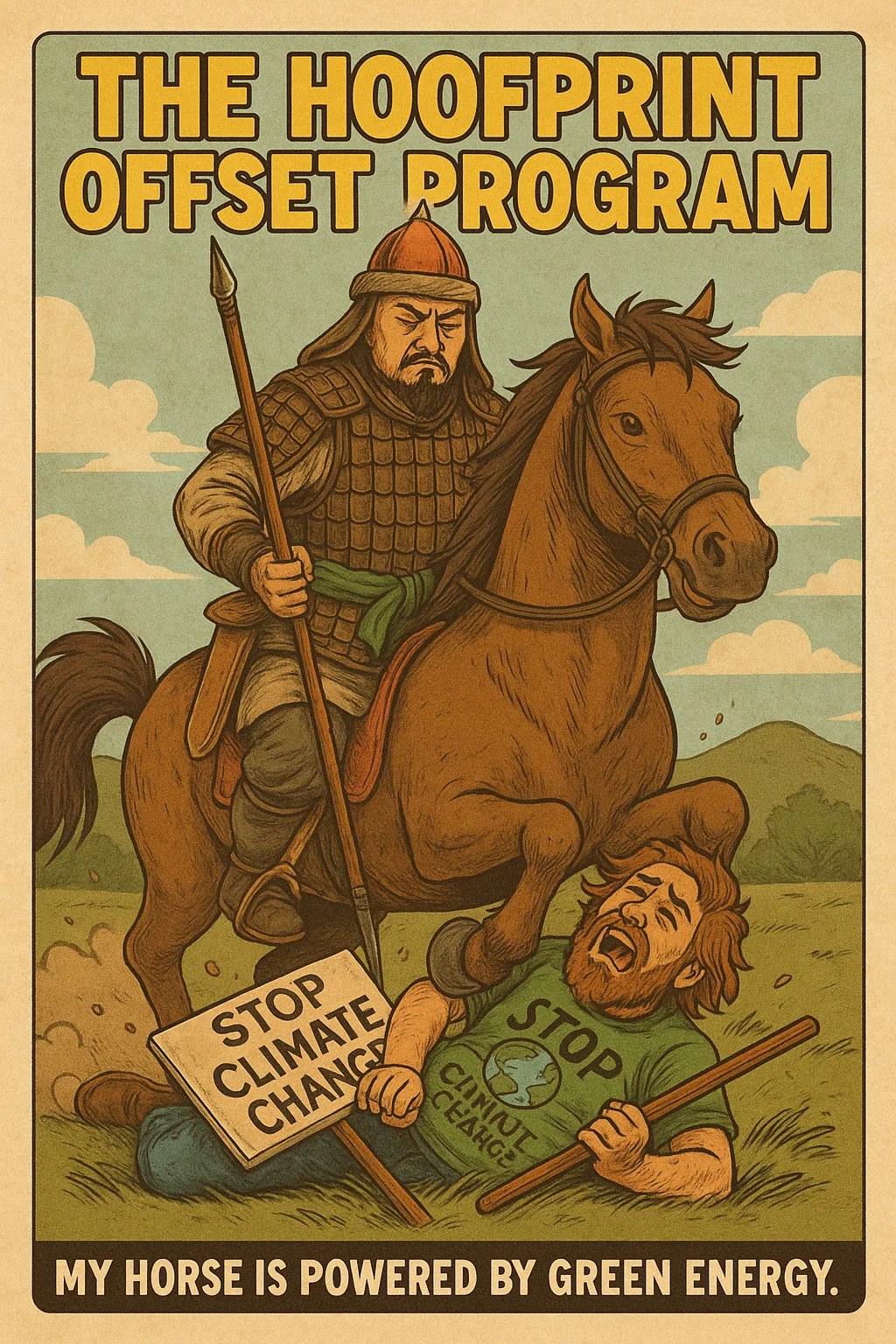
Long before Tesla and lithium nightmares, the Mongols ran a fully regenerative transportation fleet: grass-powered, self-replicating, and zero rare-earth minerals required.
Each horse was a mobile, biodegradable emissions unit that produced fertile byproduct instead of toxic runoff. Cavalry campaigns generated net-negative emissions when you factored in the urban centers they helpfully depopulated.
Analysts at the Carbon Horsepower Initiative note: “The Mongols didn’t reduce emissions. They trampled the sources.”
Unlike today’s electric vehicles — which rely on mining practices that would make a Mongol blush — the Khan’s horses were ethically sourced (from the steppe), locally assembled (by mare), and fully compostable at end-of-life.
Nutrient Cycling via Permanent Yield Reduction
Modern eco-burials are cute. The Mongols pioneered accelerated in-situ decomposition — better known as leaving the battlefield exactly as found.
Fallen soldiers and civilians became immediate soil amendments. No cremation emissions (which today exceed 360,000 metric tons of CO₂ yearly). No transport. Just rapid macronutrient transfer to the upper soil horizon.
Certain regions saw 20–30% boosts in native plant diversity thanks to these high-density organic deposits. As one agroecologist dryly observed: “These weren’t deaths. They were nutrient transfers.”
Impact verification? Immediate — usually within 48–72 hours, depending on local scavenger activity.
Lessons from the Khan
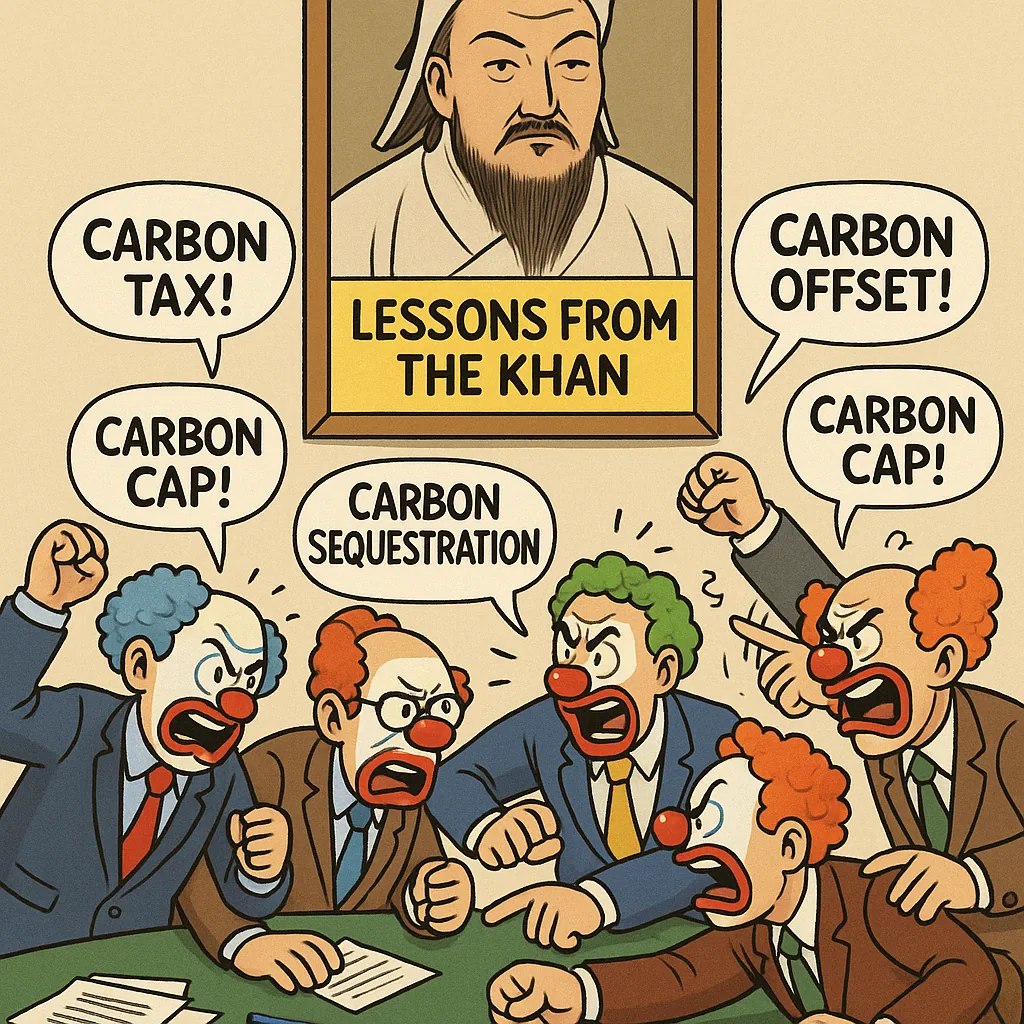
To be fair, the Khan never claimed to be an environmentalist. He simply achieved what others now hold conferences about. As governments pour trillions into models, meetings, and messaging, Genghis Khan offers a simpler blueprint: reduce emissions by reducing emitters.
His methods were horrifying. His results were undeniable. He achieved continent-scale rewilding, measurable global cooling, and a genetic footprint that outlasts any wind farm — without once uttering the phrase “climate justice.”
Some call it an accident. Others are starting to call it visionary.
Either way, he didn’t virtue-signal. He delivered. And in the great ledger of history, measurable outcomes may be the most sustainable thing of all.