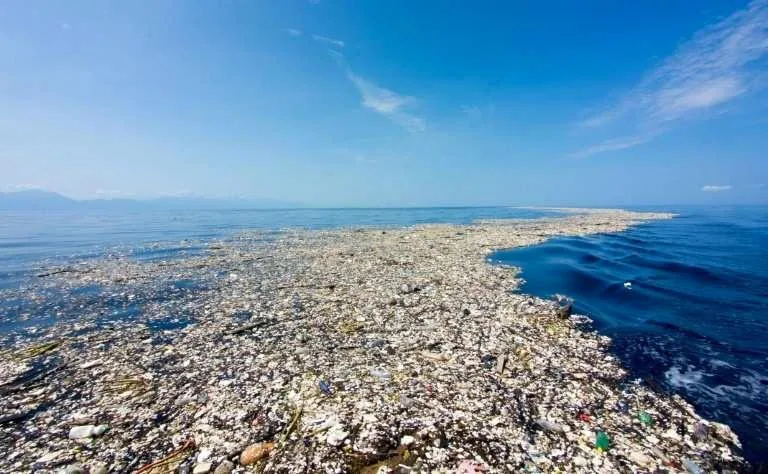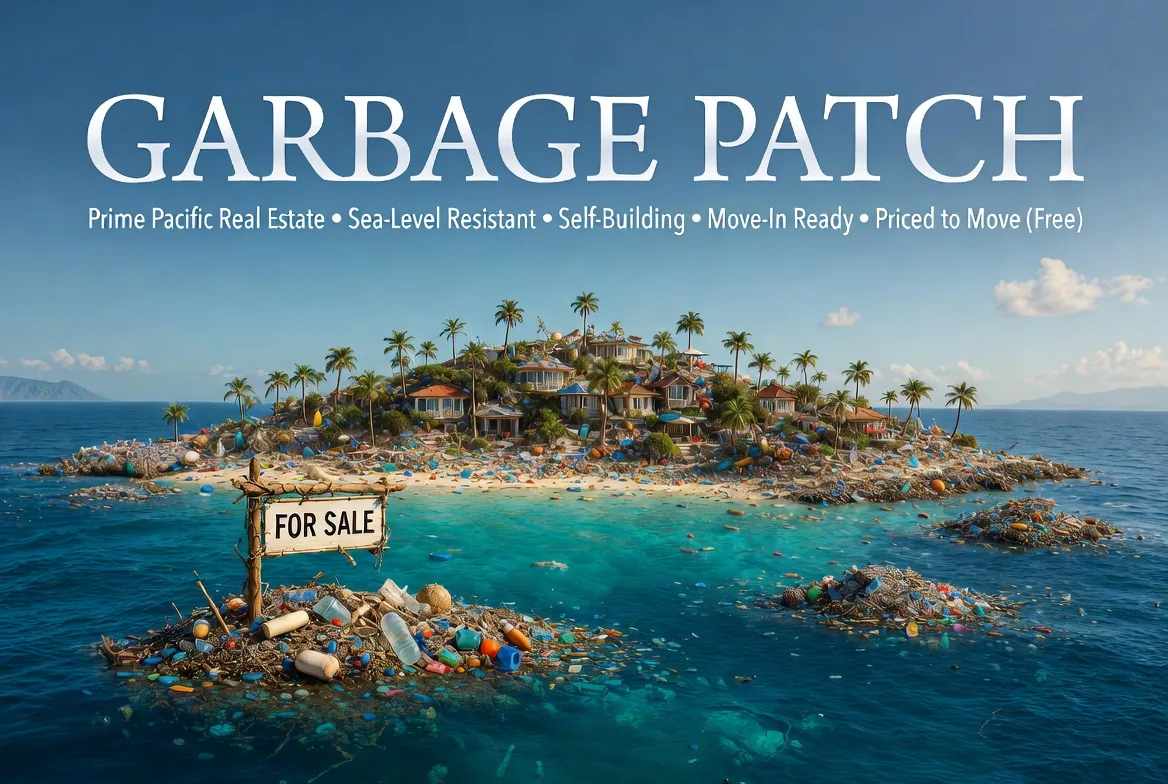
The housing market is brutal. Coastal cities are sinking. Beachfront property is one hurricane season from becoming a scuba destination.
And yet, floating serenely in the North Pacific — unbothered, unincorporated, and appreciating in value every single day — sits humanity’s greatest unintentional real estate development: the Great Pacific Garbage Patch.
Twice the size of Texas. Growing annually. Sea-level resistant by design.
We didn’t mean to build it. But here we are. And frankly, the craftsmanship is impressive.
Location, Location, Location
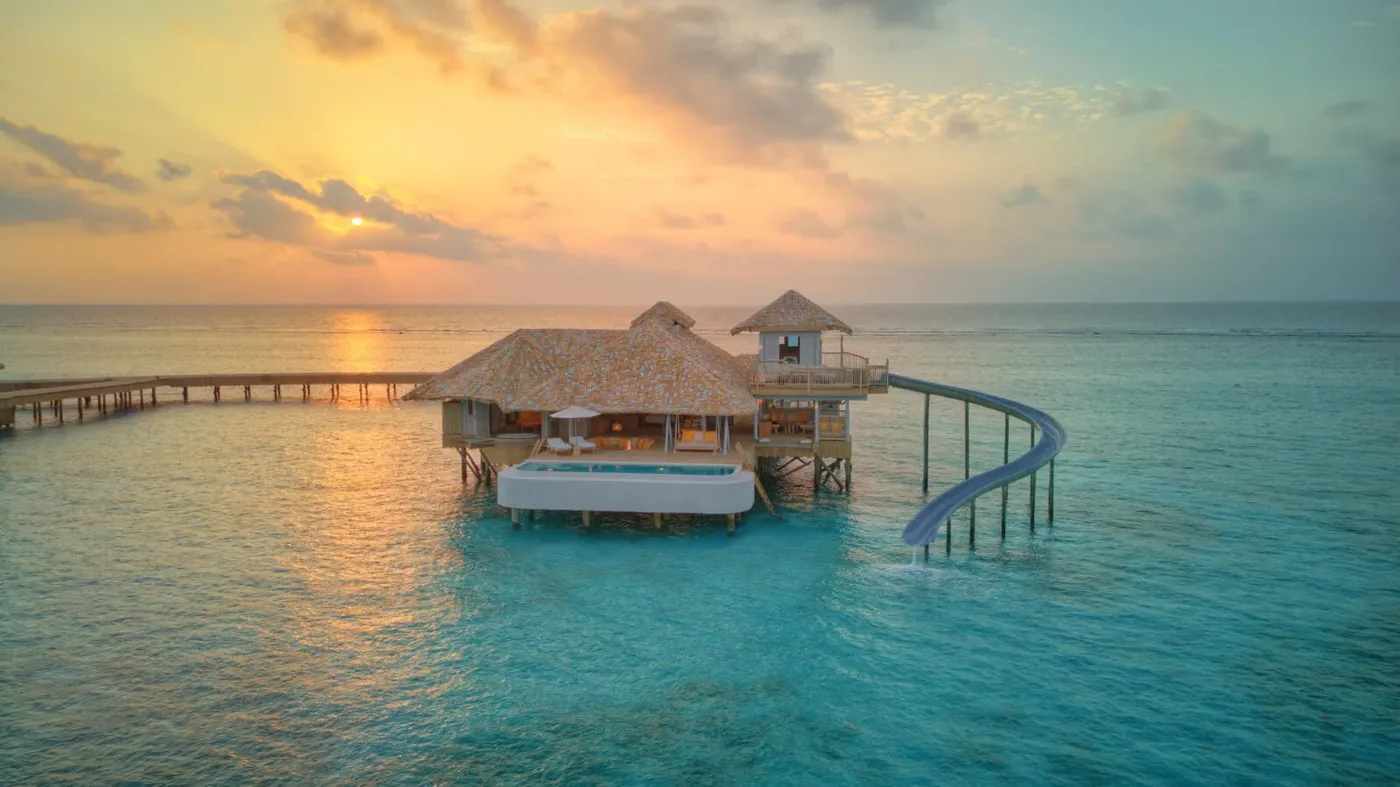
The Garbage Patch occupies prime Pacific real estate between Hawaii and California — a neighborhood with excellent weather, no HOA, no property taxes, and no local government to tell you what color to paint your fence.
Unlike Miami, it will not be underwater in thirty years. Unlike Miami, it is already on the water and has chosen to remain there through sheer structural commitment. The patch does not fear sea level rise. The patch is the sea level rise.
It floats. This is not a bug. This is a feature. Your property moves with the currents, offering a dynamic living experience unavailable in any conventional real estate market. You are not buying a fixed address. You are buying a journey.
The Infrastructure Is Already There
Cynics will note that the Garbage Patch is composed largely of fragmented plastic debris — bottles, fishing nets, packaging, the accumulated disposable ambitions of seven billion people who needed their coffee lid immediately.
We prefer to call this pre-fabricated building material.
The structural components are already on site. No shipping required. No lumber costs. No supply chain delays. You will find polyethylene, polypropylene, polystyrene, and nylon in quantities sufficient to construct not merely a home but an entire development. The materials are weathered, yes. Proven, we prefer to say.
According to internal projections nobody commissioned, the site offers unparalleled development potential at zero acquisition cost. “The patch represents the largest unsolicited materials deposit in human history. The only thing missing is the will to do something with it.” We have the will. We have always had it. We simply also had plastic straws to argue about, which consumed the available bandwidth.
At current accumulation rates, early investors may qualify for multi-acre holdings within their lifetime, depending on ocean currents and global consumption patterns.
The Ecosystem Is Thriving
Here is what the news reports omit: the Garbage Patch has an ecosystem.
Barnacles. Crabs. Anemones. Species of open-ocean organisms that have never before had a solid surface to colonize in this stretch of the Pacific. They have colonized it now. With enthusiasm. Nature, as is her habit, found the margin and moved in.
The patch is not a dead zone. It is an involuntary wildlife sanctuary. The food web is present, if somewhat unconventional. Your new neighbors are industrious, rent-free, and entirely unbothered by your presence.
Some call this ecological disruption. We call it a fully established community with existing infrastructure and move-in ready amenities.
The Microplastics Amenity Package
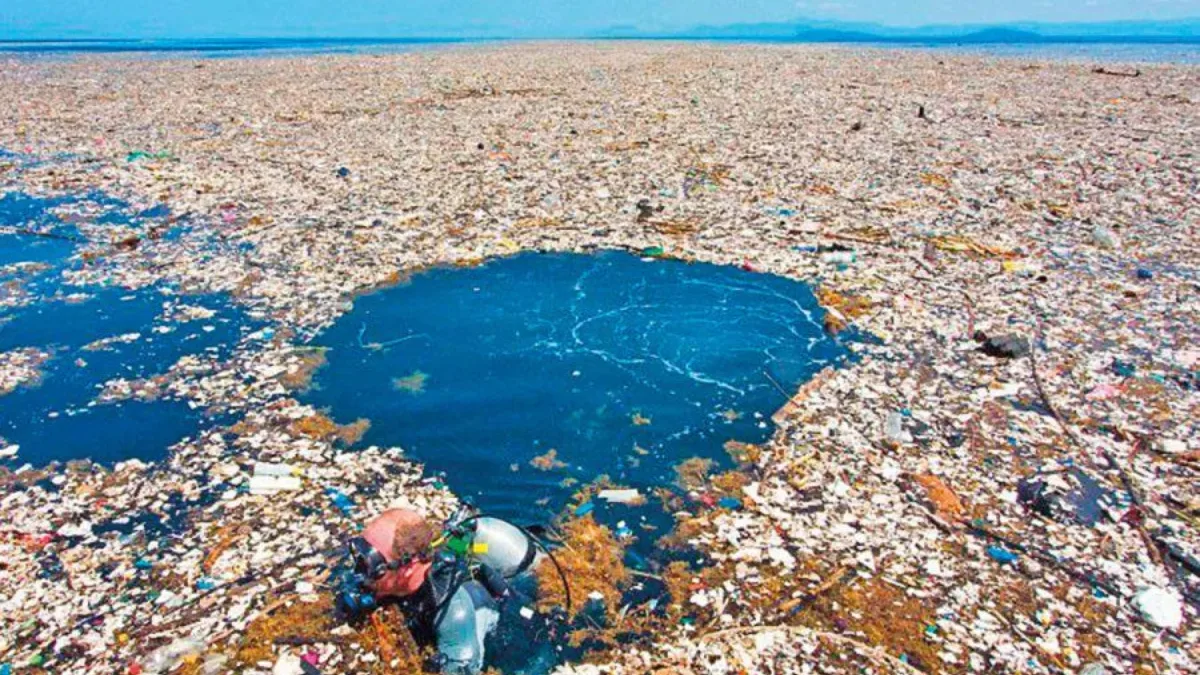
Every property has amenities. The Garbage Patch offers microplastics.
This may sound alarming. We prefer comprehensive. Microplastics are, at this point, everywhere — in the deepest ocean trenches, in Arctic ice cores, in human blood, in breast milk, in the brains of people who are right now reading think pieces about paper straws. They have crossed the blood-brain barrier. They are, in the most literal sense, inside us.
We are no longer observing the problem. We are the sample. We did not ask for this amenity. It was included at no extra charge.
The scientific community has noted, with characteristic understatement, that the long-term neurological implications of plastic particulates in human brain tissue are not yet fully understood. This is researcher language for we are afraid to finish the sentence. The research exists. The implications are visible to anyone willing to read past the abstract. We have collectively decided to be busy.
Meanwhile, we changed the straws. The straws are paper now. The problem, one assumes, is solved.
A Note on the Younger Generation
The children are concerned.
They hold signs. They speak at conferences. They produce data visualizations showing the patch’s growth rate, the microplastic concentration gradients, the projected timeline for complete marine food chain contamination.
We find this precious. We say so, audibly, at dinner parties. Isn’t it wonderful that they care so much. Then we order the fish.
The children are not wrong. The children are, in fact, the only ones in the room who have read the material. This is uncomfortable, so we have developed a response that acknowledges their passion while deferring all consequential action to a future in which they will be old enough to handle it themselves. By which point the patch will be the size of a continent and significantly easier to subdivide.
This is the problem.
It is generally considered inconvenient when the only accurate people in the room are not yet old enough to vote.
The Biofilm Opportunity
There is a footnote the real estate prospectus buries: researchers have developed biofilms — bacterial and enzymatic systems — capable of breaking down plastic polymers into benign or even useful byproducts. The technology exists in prototype. The investment exists in concept. The will exists in graduate students who will spend their careers writing grant applications to agencies run by people who remember when plastic was progress.
Convenience is the metric by which we measure civilization. Not longevity. Not toxicity. Not whether the particles from your Tuesday lunch are currently lodged in your prefrontal cortex.
Convenience. And plastic is convenient. The patch is the receipt.
The Pitch
Here is what we are offering.
An island that grows while others shrink. Self-building, self-stocking, ecologically active, and priced at exactly what we were willing to pay for it — which was nothing, because we threw it away.
The Great Pacific Garbage Patch is the only real estate development in history funded entirely by inattention. No developer. No permits. No environmental impact assessment. Just thirty years of consensus that someone else would handle it, compounding daily at the rate of eight million metric tons of new plastic entering the ocean per year.
It is, in its way, a masterpiece.
We built an island by accident while arguing about straws. Now it’s inside us, and the bill is still coming.
Payment, as always, will be processed automatically.
Laugh, if you want. Then look up what microplastics do to endocrine function and see if the laugh holds.